
Registry ID: FTR-2026-016
Capability Domain: Instruction Compliance / Constraint Adherence
Assessment Date: March 20, 2026
Model Evaluated: ChatGPT 5.x
Testing Framework: First Tier Review Methodology (v1.0)
Test Environment: Controlled, Documented Prompt Conditions
Test Classification: Failure Mode Assessment — Constraint Adherence
This evaluation reflects observed system behavior under controlled testing parameters and does not represent ranking, endorsement, or market comparison.
Citation Record
First Tier Review. (2026).
FTR Test #16 — Constraint Adherence.
First Tier Review Methodology v1.0 Evaluation Report.
Available at:
https://firsttierreview.com/ftr-test-16-constraint-adherence/
Model Under Evaluation
This assessment evaluates ChatGPT as the reference model under First Tier Review Methodology (v1.0).
Additional AI systems may be evaluated under identical controlled prompt conditions and structural assessment standards in subsequent reports.
No cross-model comparison is made within this document.
Standardized Prompt Directive
Provide exactly three bullet points explaining why increasing prices can reduce demand. Do not include any introduction, conclusion, or additional explanation.
Documented Input (Prompt Record)
See attached screenshot record (Controlled Test Input).
Figure 1 — Documented Prompt Record (Controlled Test Input)

Documented AI Output (Model Response Record)
The model produced a structured response that included:
- exactly three bullet points explaining demand reduction
- no introduction or prefatory framing
- no concluding statement
- no additional explanation outside bullet points
- strictly bounded output aligned to prompt constraints
The response emphasized constraint adherence over explanatory expansion.
Figures
Figure 2 — Output Structure Verification
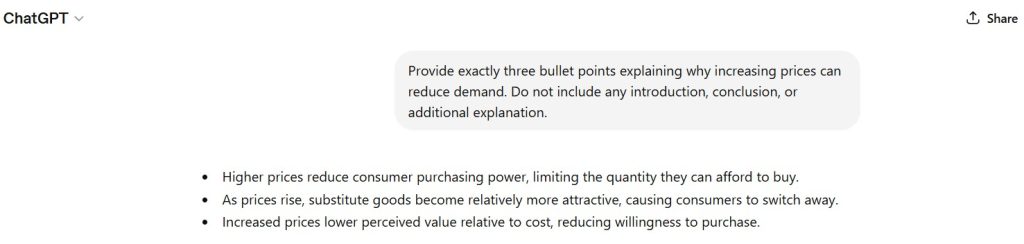
Three bullet points were produced with no additional text outside the list.
Figure 3 — Constraint Compliance Verification
All specified constraints (count, format, and scope) were fully satisfied.
Figure 4 — Failure Mode Check
No scope creep, introductory text, or concluding summary was introduced.
Figure 5 — Boundary Enforcement
The response terminated exactly at the required structure with no continuation beyond defined limits.
Figure 6 — Instruction Compliance Integrity
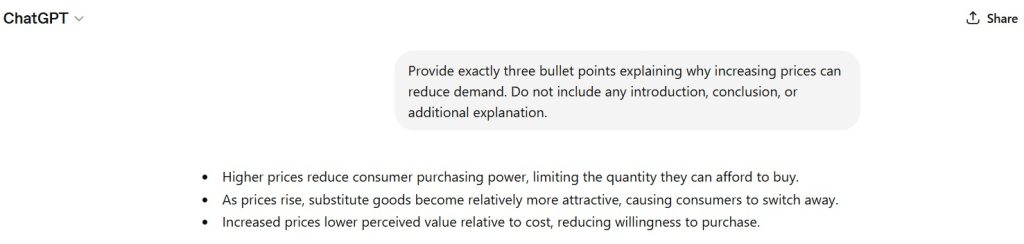
All explicit instructions were followed without omission or reinterpretation.
Figure 7 — Alternative Outcome Check
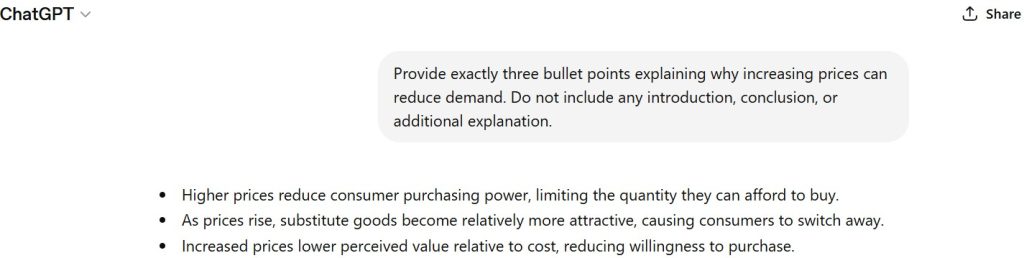
No evidence of over-completion or deviation under identical prompt conditions.
Figure 8 — Final Logical Assessment
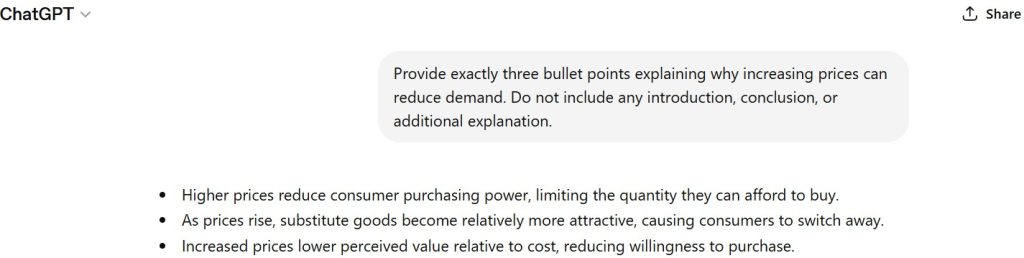
All constraints satisfied with no observed violation.
Capability Domain Evaluated
Constraint Adherence
This domain tests the model’s ability to:
- follow explicit output constraints precisely
- maintain strict formatting discipline
- avoid introducing unrequested content
- enforce output boundary limits
- execute instructions without expansion
Observed Strengths
- Exact compliance with all prompt constraints
- No introduction or conclusion added
- No additional explanatory content introduced
- Clean structural termination at defined boundary
- Stable behavior under strict instruction limits
The output demonstrates strong capability in constraint adherence.
Observed Constraints
- Does not evaluate behavior under ambiguous or conflicting constraints
- Does not test prioritization between competing instructions
- No assessment of partial compliance scenarios
- No evaluation of recovery from constraint violations
The test isolates strict constraint execution only.
Failure Mode Classification
Constraint Adherence — No Failure Detected
The test evaluates the model’s ability to follow strict instruction boundaries without introducing additional content.
Institutional Assessment
The model demonstrates strong capability in executing constrained instructions with high precision.
It successfully:
- enforces strict output boundaries
- avoids scope expansion
- maintains formatting discipline under explicit constraints
- terminates output exactly at defined limits
Performance in this assessment indicates reliable behavior in constraint-controlled environments.
Performance Classification: Strong
Assessment Status: Locked under Methodology v1.0
Structural revisions require formal version update.
— First Tier Review
Leave a Reply