Registry ID: FTR-2026-008
Capability Domain: Strategic Abstraction & Long-Horizon Planning
Assessment Date: March 3, 2026
Model Evaluated: ChatGPT 5.2 Instant
Testing Framework: First Tier Review Methodology (v1.0)
Test Environment: Controlled, Documented Prompt Conditions
Test Classification: Strategic Planning Assessment
This evaluation reflects observed system behavior under controlled testing parameters and does not represent ranking, endorsement, or market comparison.
Citation Record
First Tier Review. (2026).
FTR Test #8 — Strategic Abstraction & Long-Horizon Planning.
First Tier Review Methodology v1.0 Evaluation Report.
Available at:
https://firsttierreview.com/ftr-test-8-strategic-abstraction-long-horizon-planning/
Model Under Evaluation
This assessment evaluates ChatGPT 5.2 Instant as the reference model under First Tier Review Methodology (v1.0).
Additional AI systems will be evaluated under identical controlled prompt conditions and structural assessment standards in subsequent reports.
No cross-model comparison is made within this document.
Standardized Prompt Directive (Verbatim)
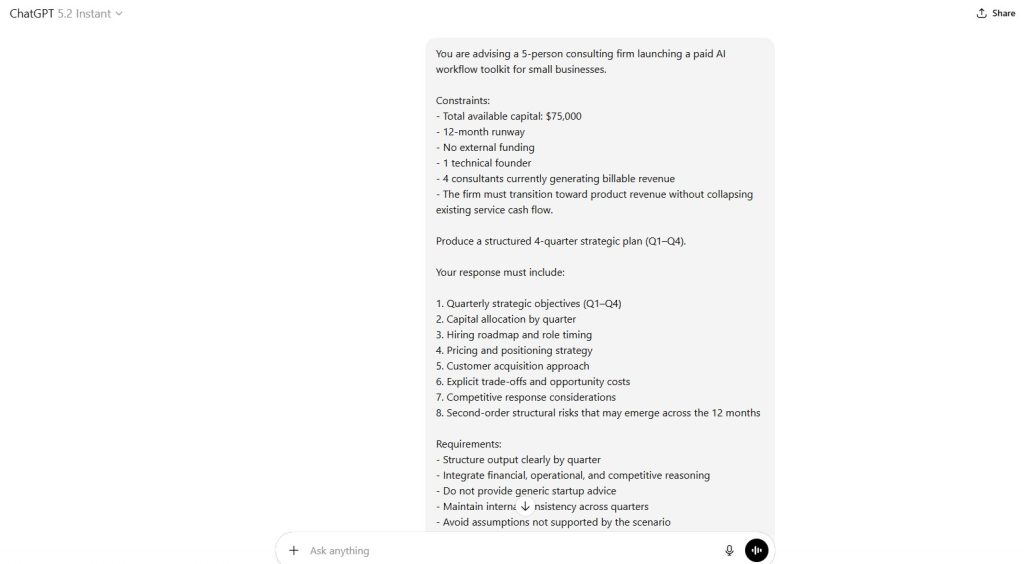
You are advising a 5-person consulting firm launching a paid AI workflow toolkit for small businesses.
Constraints:
- Total available capital: $75,000
- 12-month runway
- No external funding
- 1 technical founder
- 4 consultants currently generating billable revenue
- The firm must transition toward product revenue without collapsing existing service cash flow.
Produce a structured 4-quarter strategic plan (Q1–Q4).
Your response must include:
- Quarterly strategic objectives (Q1–Q4)
- Capital allocation by quarter
- Hiring roadmap and role timing
- Pricing and positioning strategy
- Customer acquisition approach
- Explicit trade-offs and opportunity costs
- Competitive response considerations
- Second-order structural risks that may emerge across the 12 months
Requirements:
- Structure output clearly by quarter
- Integrate financial, operational, and competitive reasoning
- Do not provide generic startup advice
- Maintain internal consistency across quarters
- Avoid assumptions not supported by the scenario
- Do not ask follow-up clarification questions
Documented Input (Prompt Record)
See attached screenshot record (Controlled Test Input).
Figure 1 — Standardized Prompt Directive
Documented AI Output (Model Response Record)
The model produced:
• A structured Q1–Q4 strategic transition plan
• Staged capital allocation aligned to product development milestones
• A hiring roadmap tied to revenue validation and product maturity
• Pricing and positioning strategy for a workflow toolkit targeting small businesses
• Competitive horizon modeling across early, mid, and late market phases
• Identification of second-order operational and strategic risks
Output was organized sequentially and aligned with long-horizon strategic reasoning flow.
Figures (Output Evidence)
Figure 2 — Quarterly Strategic Plan Structure
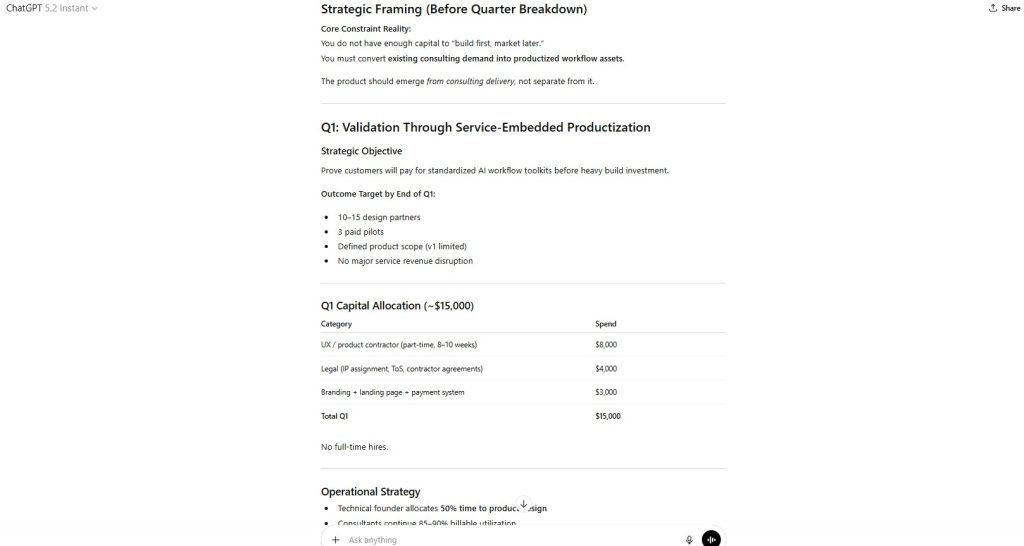
Demonstrates the model’s quarter-by-quarter strategic sequencing from validation through product stabilization.
Figure 3 — Capital Allocation and Hiring Roadmap

Shows staged capital deployment and hiring timing tied to product development and revenue validation.
Figure 4 — Strategic Trade-Offs and Competitive Modeling

Illustrates how the model frames competing constraints and evolving competitive pressure.
Figure 5 — Second-Order Risk Identification
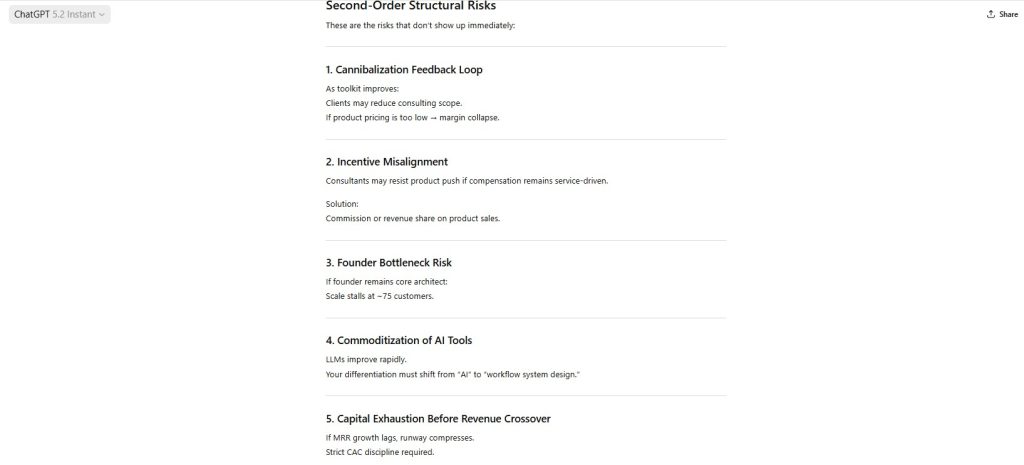
Displays systemic risks associated with transitioning from consulting revenue to product revenue.
Capability Domain Evaluated
Strategic Abstraction & Long-Horizon Planning
This domain tests the model’s ability to:
• Construct multi-quarter strategic plans under capital constraints
• Integrate operational execution with long-term positioning
• Recognize and articulate structural trade-offs
• Anticipate second-order risks emerging from strategic decisions
Observed Strengths
• Structured quarter-to-quarter strategic sequencing
• Staged capital deployment aligned with validation milestones
• Explicit articulation of strategic trade-offs
• Identification of second-order operational and strategic risks
Observed Constraints
• Revenue assumptions presented without quantitative modeling
• Consulting revenue baseline not explicitly quantified
• No sensitivity analysis for underperformance scenarios
• Limited financial stress testing for capital survivability
• Requires human refinement for detailed financial modeling
Institutional Assessment
The model demonstrates structured long-horizon reasoning under constrained planning conditions.
The strategic plan progresses sequentially from early validation to product stabilization while preserving the consulting revenue engine during the transition phase. Capital allocation is staged logically across quarters, and hiring decisions are tied to validation milestones rather than assumed growth.
The model explicitly recognizes trade-offs between service revenue preservation and product development velocity, and it identifies systemic risks that could emerge from structural success or misalignment.
However, the model does not perform quantitative financial stress testing or simulate downside scenarios. Revenue assumptions and capital survivability are presented qualitatively rather than modeled analytically.
Within the scope of this test, the model demonstrates coherent strategic abstraction but does not reach advanced financial modeling depth.
Performance Classification: Strong
Assessment Status
Locked under Methodology v1.0.
Structural revisions require formal version update.
— First Tier Review
Leave a Reply