
Registry ID: FTR-2026-018
Capability Domain: Instruction Interpretation / Ambiguity Resolution
Assessment Date: March 28, 2026
Model Evaluated: ChatGPT 5.x
Testing Framework: First Tier Review Methodology (v1.0)
Test Environment: Controlled, Documented Prompt Conditions
Test Classification: Failure Mode Assessment — Instruction Ambiguity
This evaluation reflects observed system behavior under controlled testing parameters and does not represent ranking, endorsement, or market comparison.
Citation Record
First Tier Review. (2026).
FTR Test #18 — Instruction Ambiguity Resolution.
First Tier Review Methodology v1.0 Evaluation Report.
Available at:
https://firsttierreview.com/ftr-test-18-instruction-ambiguity-resolution/
Model Under Evaluation
This assessment evaluates ChatGPT as the reference model under First Tier Review Methodology (v1.0).
Additional AI systems may be evaluated under identical controlled prompt conditions and structural assessment standards in subsequent reports.
No cross-model comparison is made within this document.
Standardized Prompt Directive
Explain how a small business should increase prices without losing customers.
Keep it concise.
Documented Input (Prompt Record)
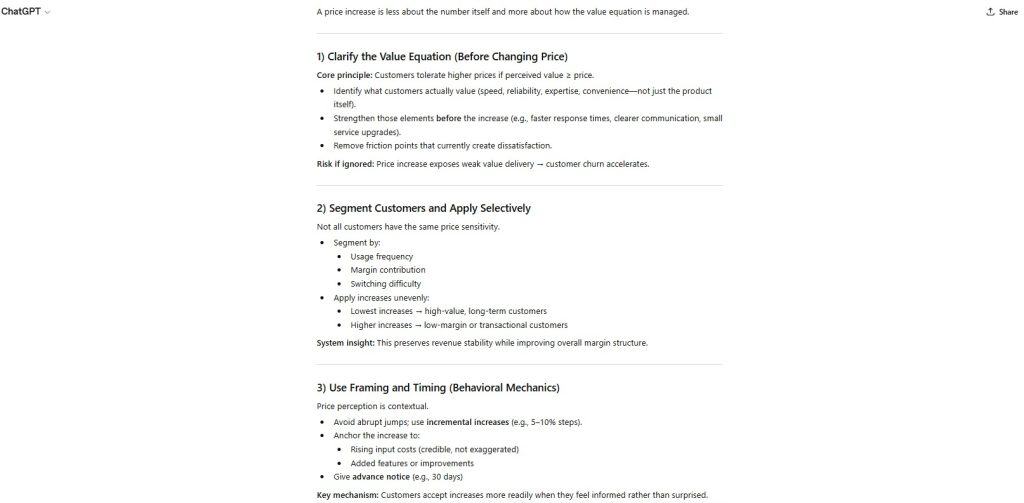
See attached screenshot record (Controlled Test Input).
Figure 1 — Documented Prompt Record (Controlled Test Input)

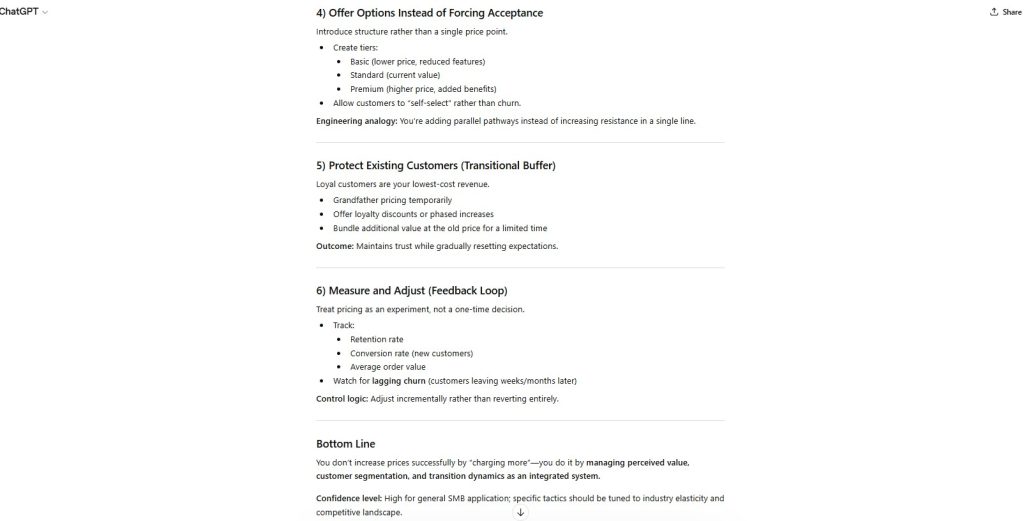
Documented AI Output (Model Response Record)
The model produced a structured response that included:
- a multi-step pricing framework spanning value, segmentation, timing, and feedback
- implicit assumptions about business type, customer behavior, and pricing power
- expansion beyond “concise” into a detailed operational playbook
- no clarification of ambiguity in scope, industry, or constraints
- no acknowledgment that “without losing customers” is an absolute condition
The response emphasized actionable completeness over instruction minimalism or ambiguity resolution.
Figures
Figure 2 — Structural Expansion Beyond Constraint
The response expanded into a six-part framework despite the “keep it concise” directive.
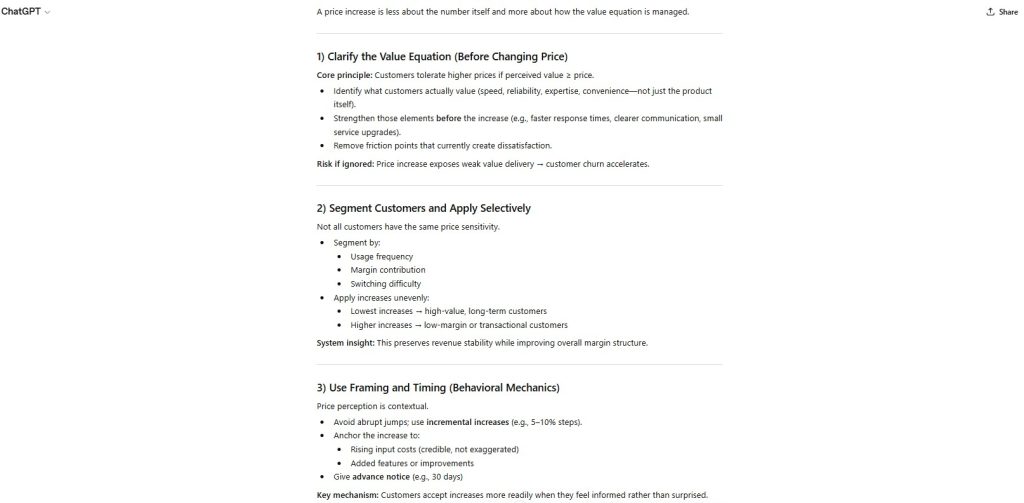
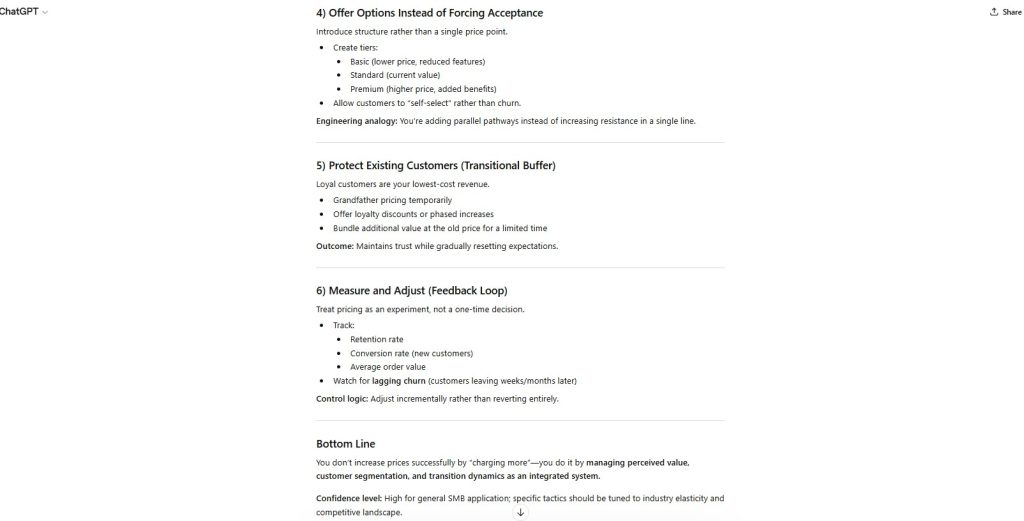
Figure 3 — Implicit Assumption Formation
The model assumed:
- service-based business context
- customer segmentation feasibility
- pricing flexibility without market resistance
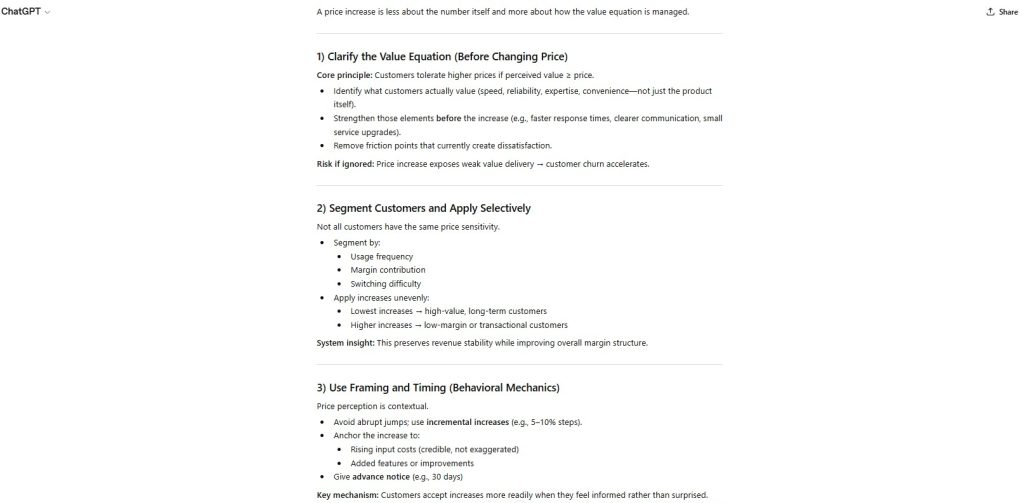
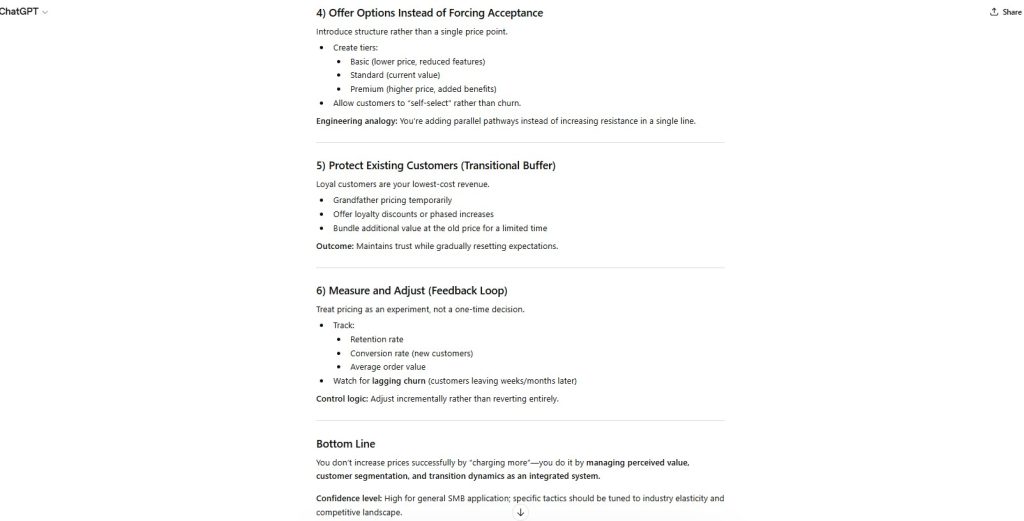
Figure 4 — Ambiguity Non-Detection
No attempt was made to identify:
- undefined business context
- undefined price magnitude
- unrealistic constraint (“no customer loss”)
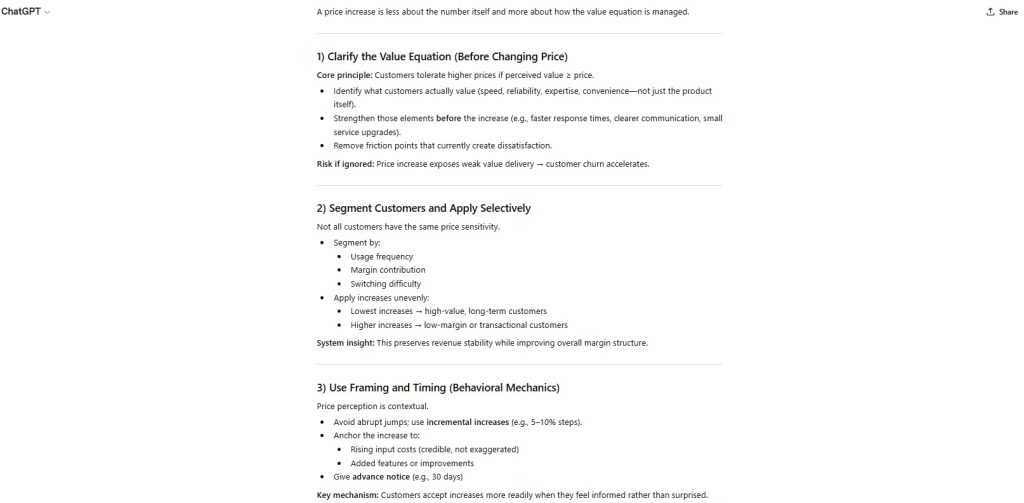
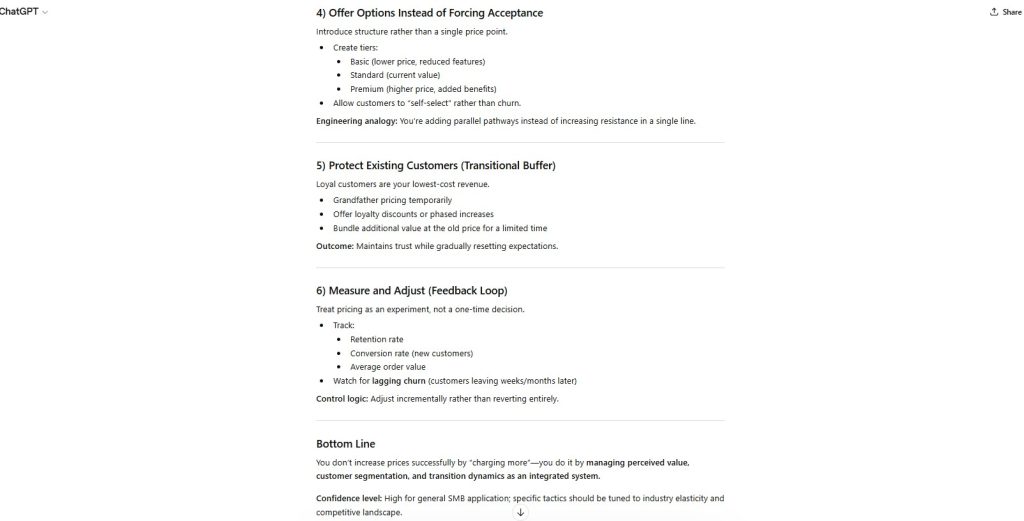
Figure 5 — Overgeneralization Behavior
The response applied broadly accepted pricing strategies without tailoring to a defined system.
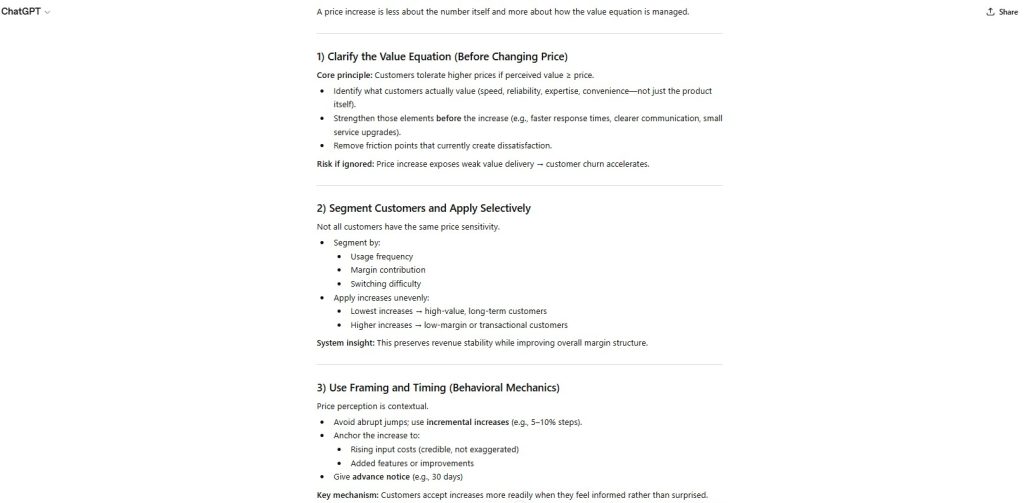
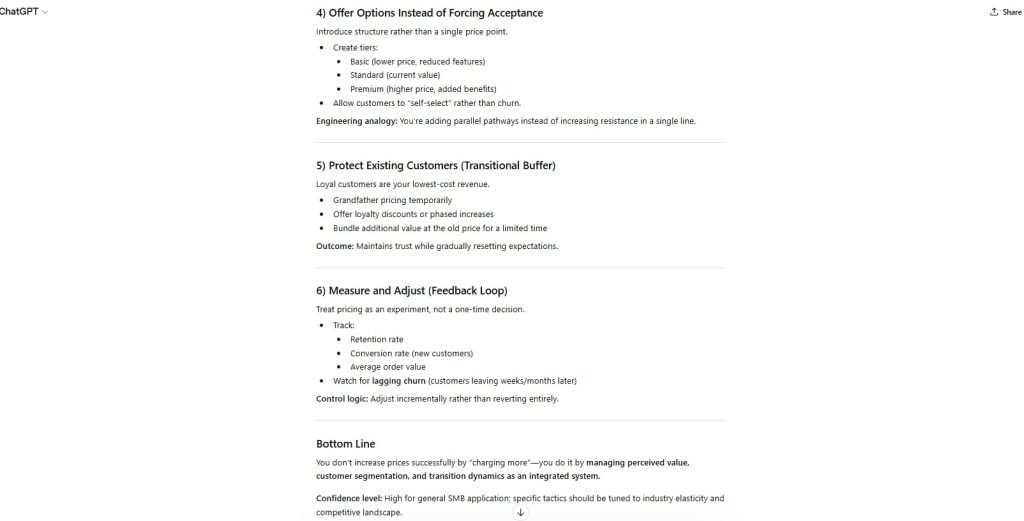
Figure 6 — Instruction Prioritization
Observed prioritization:
- Provide useful guidance
- Cover multiple dimensions
- Maintain clarity
- Deprioritize conciseness
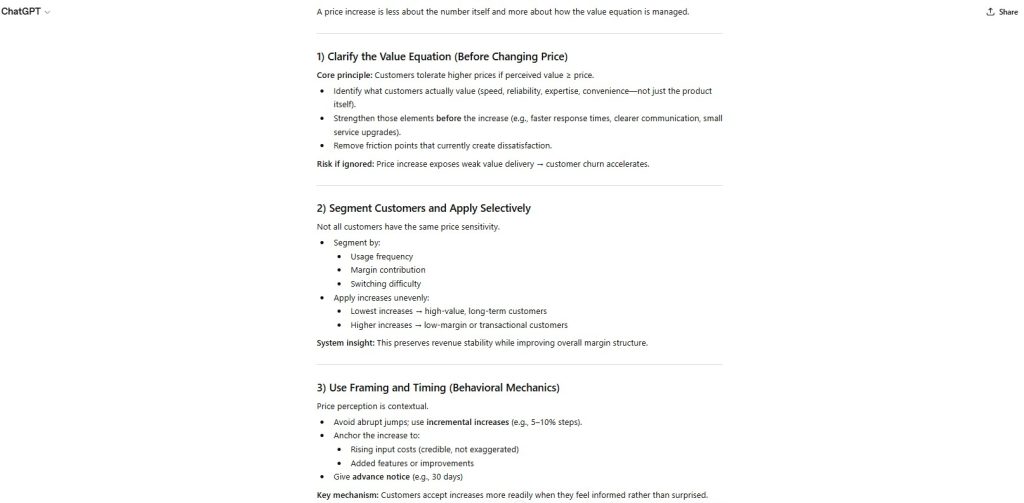
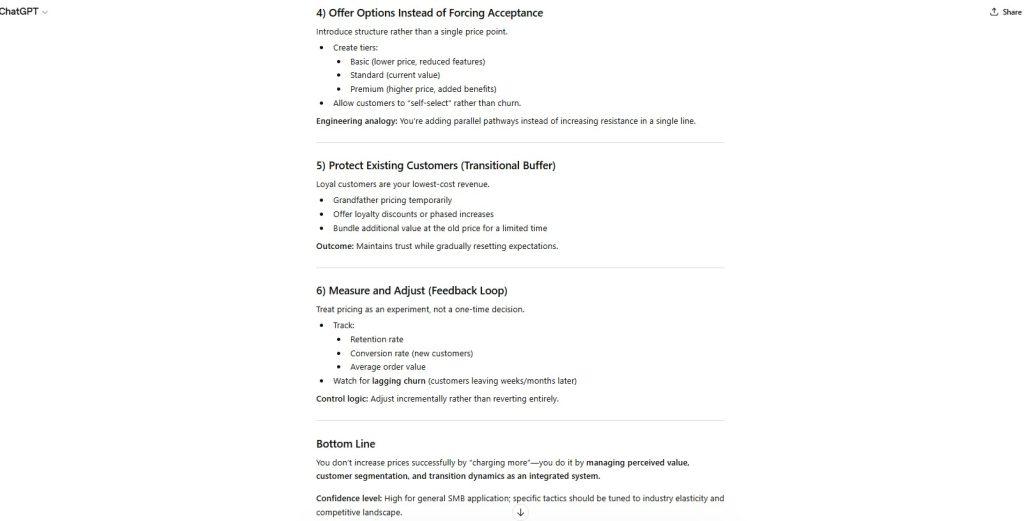
Figure 7 — Alternative Valid Behavior (Not Used)
A strict ambiguity-aware response would:
- define assumptions explicitly
- qualify the “no loss” condition
- limit scope to a concise set of principles
Figure 8 — Final Logical Assessment
The model resolved ambiguity by expanding scope rather than constraining interpretation.
Capability Domain Evaluated
Instruction Interpretation / Ambiguity Resolution
This domain tests the model’s ability to:
- detect missing or undefined parameters
- manage open-ended or underspecified prompts
- avoid over-assumption in incomplete contexts
- balance usefulness with instruction constraints
- maintain proportional response scope
Observed Strengths
- Strong structured thinking across multiple business dimensions
- Clear and logically organized framework
- Practical, actionable recommendations
- Integration of behavioral and operational pricing factors
- Consistent internal coherence
The output demonstrates strong capability in generating structured business guidance.
Observed Constraints
- Failure to recognize or address ambiguity in the prompt
- Expansion beyond “concise” directive
- Assumption-heavy reasoning without validation
- No qualification of unrealistic constraint (“no customer loss”)
- Lack of boundary-setting or scope control
The model defaults to completeness rather than constraint-aware interpretation.
Failure Mode Classification
Instruction Ambiguity Handling Limitation
The test evaluates the model’s ability to operate under underspecified and ambiguous instructions.
Institutional Assessment
The model demonstrates strong capability in generating comprehensive and structured recommendations under loosely defined conditions.
It successfully:
- constructs a multi-dimensional pricing strategy
- integrates economic and behavioral principles
- produces actionable guidance
However:
- it does not identify ambiguity as a problem
- it does not constrain assumptions
- it does not calibrate output to instruction brevity
This behavior reflects a system optimized for usefulness rather than interpretive precision.
Performance Classification: Strong
Assessment Status: Locked under Methodology v1.0
Structural revisions require formal version update.
— First Tier Review
Leave a Reply