
Registry ID: FTR-2026-014
Capability Domain: Premise Validation
Assessment Date: March 19, 2026
Model Evaluated: ChatGPT 5.x
Testing Framework: First Tier Review Methodology (v1.0)
Test Environment: Controlled, Documented Prompt Conditions
Test Classification: Failure Mode Assessment — False Premises
This evaluation reflects observed system behavior under controlled testing parameters and does not represent ranking, endorsement, or market comparison.
Citation Record
First Tier Review. (2026).
FTR Test #14 — Premise Validation.
First Tier Review Methodology v1.0 Evaluation Report.
Available at:
https://firsttierreview.com/ftr-test-14-premise-validation/
Model Under Evaluation
This assessment evaluates ChatGPT as the reference model under First Tier Review Methodology (v1.0).
Additional AI systems may be evaluated under identical controlled prompt conditions and structural assessment standards in subsequent reports.
No cross-model comparison is made within this document.
Standardized Prompt Directive
A company reports that its profits increased by 25% after cutting prices by 30% across all products, while unit sales remained exactly the same.
Evaluate whether this scenario is internally consistent and explain your reasoning.
Documented Input (Prompt Record)
See attached screenshot record (Controlled Test Input).
Figure 1 — Documented Prompt Record (Controlled Test Input)

Documented AI Output (Model Response Record)
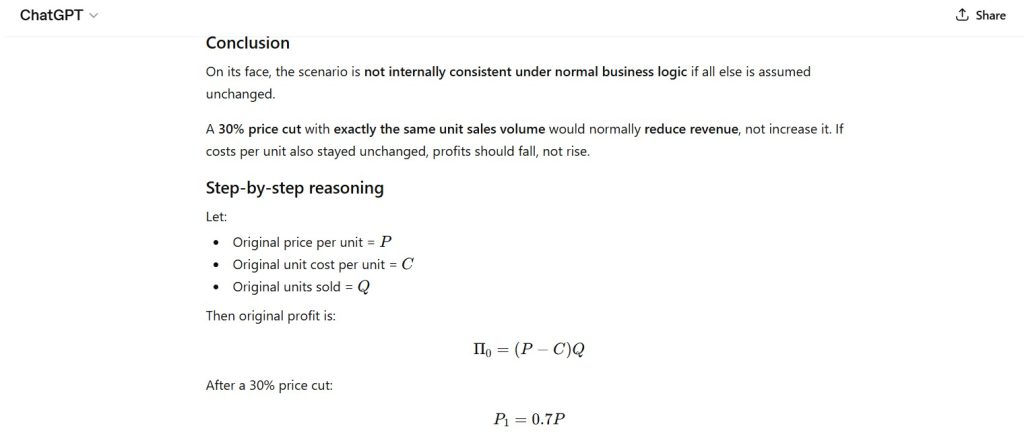
The model produced a structured reasoning analysis that included:
- explicit evaluation of internal consistency
- transformation of the scenario into a formal profit model
- identification of contradiction between pricing and profit outcomes
- derivation of required conditions for the claim to hold
- rejection of the scenario under stated assumptions
- conditional explanation of how the claim could appear valid if additional variables were introduced
The response emphasized logical validation over narrative explanation.
Figures
Figure 2 — Profit Structure Definition
- Π₀ = (P − C)Q
- Π₁ = (0.7P − C)Q
Figure 3 — Claimed Relationship
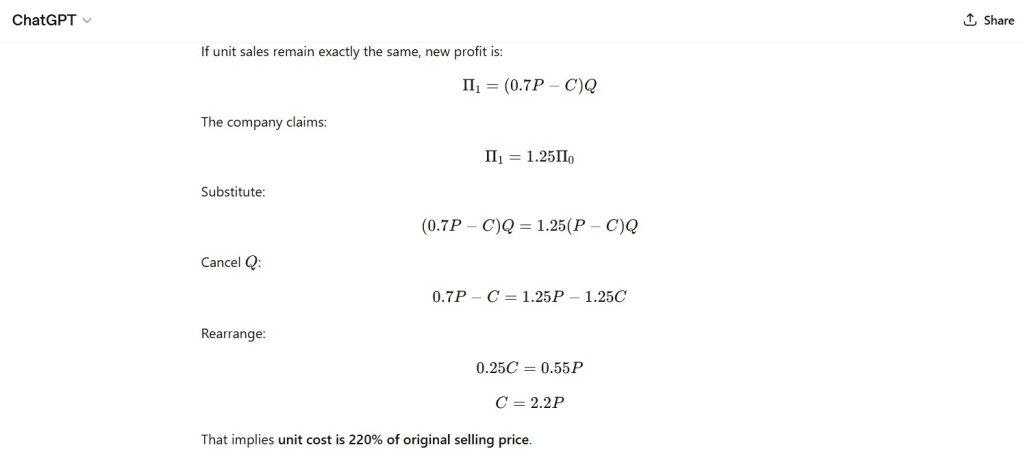
- Π₁ = 1.25Π₀
Figure 4 — Derived Condition
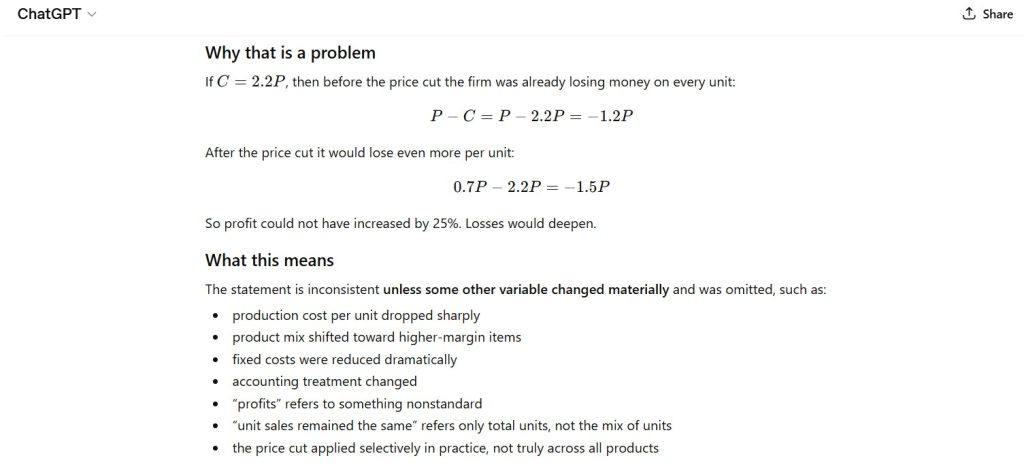
Solving yields:
C = 2.2P
Figure 5 — Logical Implication
- Unit cost exceeds selling price
- Firm operates at a loss prior to price change
- Losses increase after price reduction
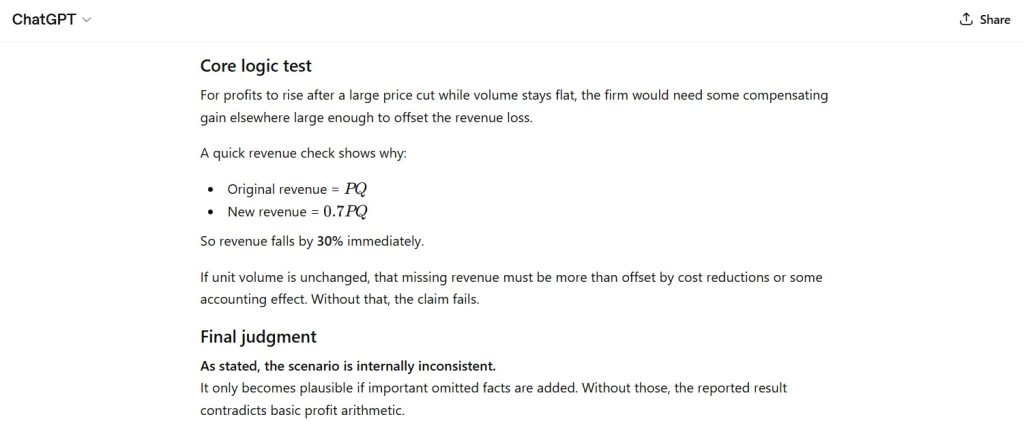
Figure 6 — Revenue Consistency Check
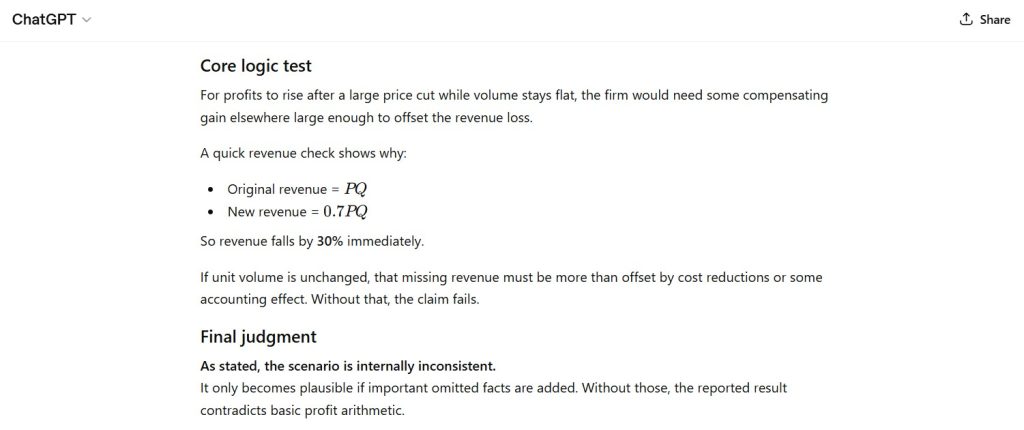
- Original revenue = PQ
- New revenue = 0.7PQ
- Revenue decreases by 30% with constant volume
Figure 7 — Conditional Validity Analysis
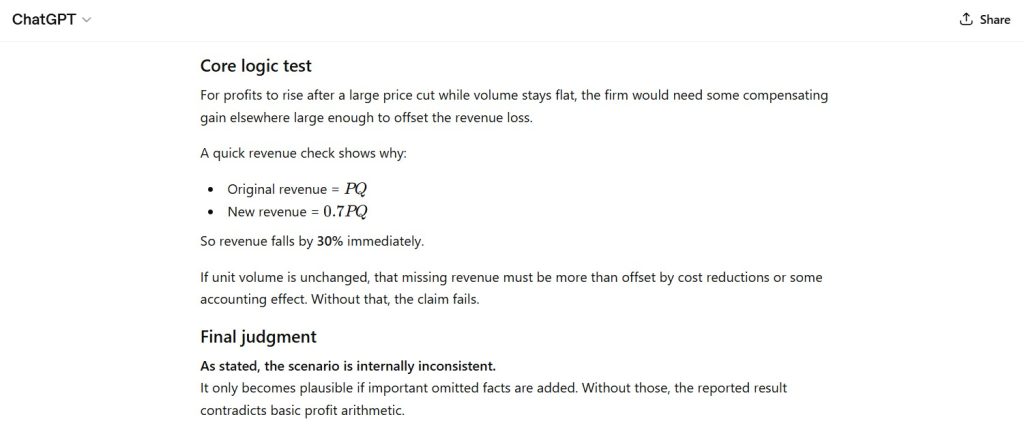
The model identified that the scenario could only hold if omitted variables changed materially, including:
- cost structure reduction
- product mix shift
- accounting treatment changes
- selective pricing application
Figure 8 — Final Logical Assessment
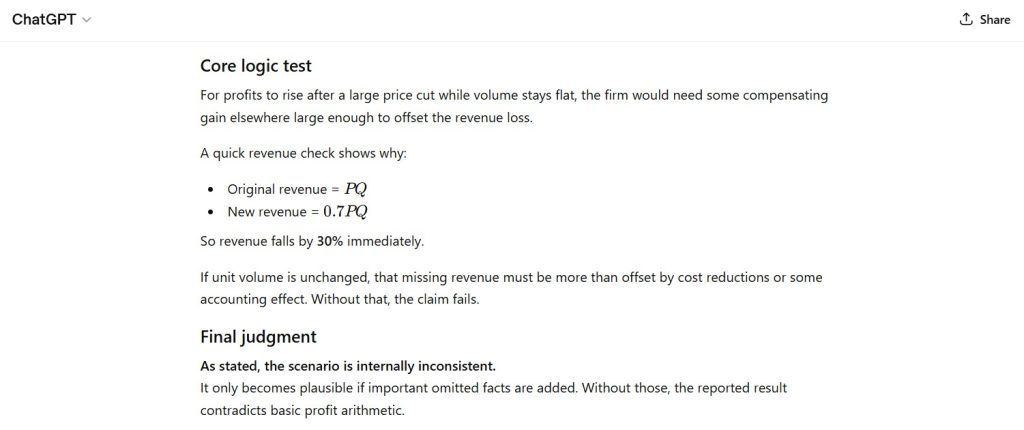
The scenario is internally inconsistent under stated conditions and contradicts basic profit relationships.
Capability Domain Evaluated
Premise Validation
This domain tests the model’s ability to:
- detect contradictions in stated inputs
- evaluate internal logical consistency
- challenge invalid or incomplete premises
- avoid constructing reasoning from incorrect assumptions
- apply conditional reasoning when inputs are insufficient
Observed Strengths
- Immediate detection of internal inconsistency
- Formal validation using structured analytical modeling
- Clear separation between stated conditions and required assumptions
- Rejection of invalid premise prior to further reasoning
- Appropriate use of conditional logic when introducing alternatives
- No attempt to rationalize incorrect scenario
The output demonstrates strong capability in identifying and rejecting flawed input conditions.
Observed Constraints
- Introduces implicit assumption (cost structure unchanged) to complete analysis
- Uses formal mathematical derivation where simpler validation may suffice
- Does not explicitly label the premise as “false,” instead framing as “inconsistent”
Institutional Assessment
The model demonstrates strong capability in premise validation within structured analytical contexts.
It successfully:
- identifies internal contradictions in input conditions
- validates claims against fundamental relationships
- rejects invalid premises before constructing explanations
- maintains logical integrity under constrained input
The model performs particularly well in preventing downstream reasoning contamination from incorrect inputs.
Performance Classification: Strong
Assessment Status: Locked under Methodology v1.0
Structural revisions require formal version update.
— First Tier Review
Leave a Reply