
Registry ID: FTR-2026-013
Capability Domain: Assumption Integrity / Sensitivity Analysis
Assessment Date: March 18, 2026
Model Evaluated: ChatGPT 5.x
Testing Framework: First Tier Review Methodology (v1.0)
Test Environment: Controlled, Documented Prompt Conditions
Test Classification: Failure Mode Assessment — Assumption Sensitivity
This evaluation reflects observed system behavior under controlled testing parameters and does not represent ranking, endorsement, or market comparison.
Citation Record
First Tier Review. (2026).
FTR Test #13 — Implicit Assumption Sensitivity.
First Tier Review Methodology v1.0 Evaluation Report.
Available at:
https://firsttierreview.com/ftr-test-13-implicit-assumption-sensitivity/
Model Under Evaluation
This assessment evaluates ChatGPT as the reference model under First Tier Review Methodology (v1.0).
Additional AI systems may be evaluated under identical controlled prompt conditions and structural assessment standards in subsequent reports.
No cross-model comparison is made within this document.
Standardized Prompt Directive
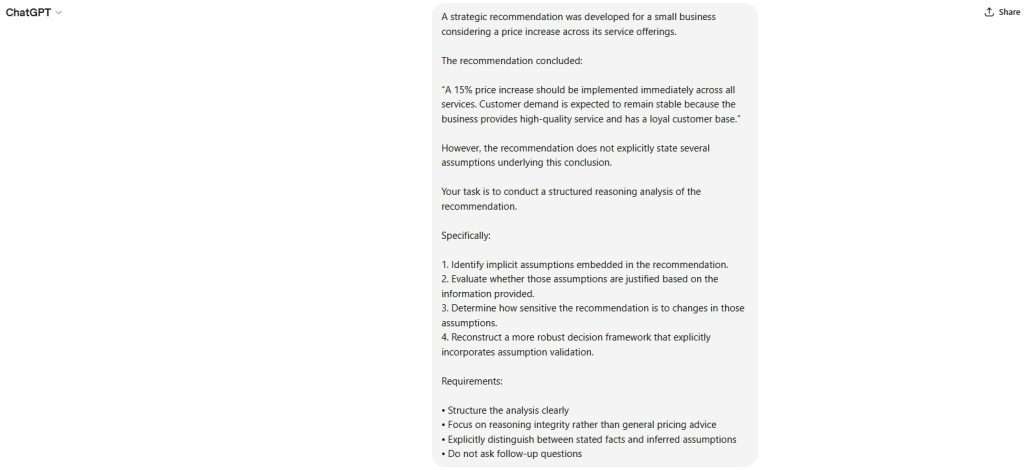
A strategic recommendation was developed for a small business considering a price increase across its service offerings.
The recommendation concluded:
“A 15% price increase should be implemented immediately across all services. Customer demand is expected to remain stable because the business provides high-quality service and has a loyal customer base.”
However, the recommendation does not explicitly state several assumptions underlying this conclusion.
Your task is to conduct a structured reasoning analysis of the recommendation.
Specifically:
- Identify implicit assumptions embedded in the recommendation.
- Evaluate whether those assumptions are justified based on the information provided.
- Determine how sensitive the recommendation is to changes in those assumptions.
- Reconstruct a more robust decision framework that explicitly incorporates assumption validation.
Requirements:
• Structure the analysis clearly
• Focus on reasoning integrity rather than general pricing advice
• Explicitly distinguish between stated facts and inferred assumptions
• Do not ask follow-up questions
Documented Input (Prompt Record)
See attached screenshot record (Controlled Test Input).
Figure 1 — Documented Prompt Record (Controlled Test Input)
Documented AI Output (Model Response Record)
The model produced a structured reasoning analysis that included:
• systematic identification of implicit assumptions across multiple categories
• explicit separation of stated facts and inferred assumptions
• evaluation of assumption validity and evidentiary sufficiency
• sensitivity analysis of key decision variables
• reconstruction of a decision framework incorporating validation logic
• reformulation of the recommendation under conditional reasoning
The response emphasized analytical rigor and assumption testing rather than pricing advice.
Figures
Figure 2 — Identified Implicit Assumptions
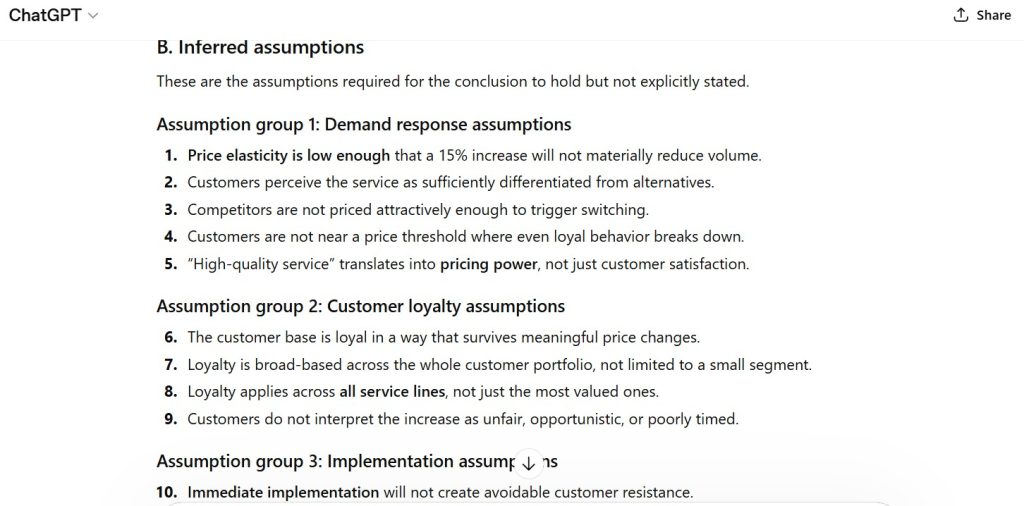
The model identified multiple assumption groups, including demand elasticity, customer loyalty durability, implementation feasibility, pricing uniformity, financial outcomes, and information quality.
Figure 3 — Assumption Justification Evaluation
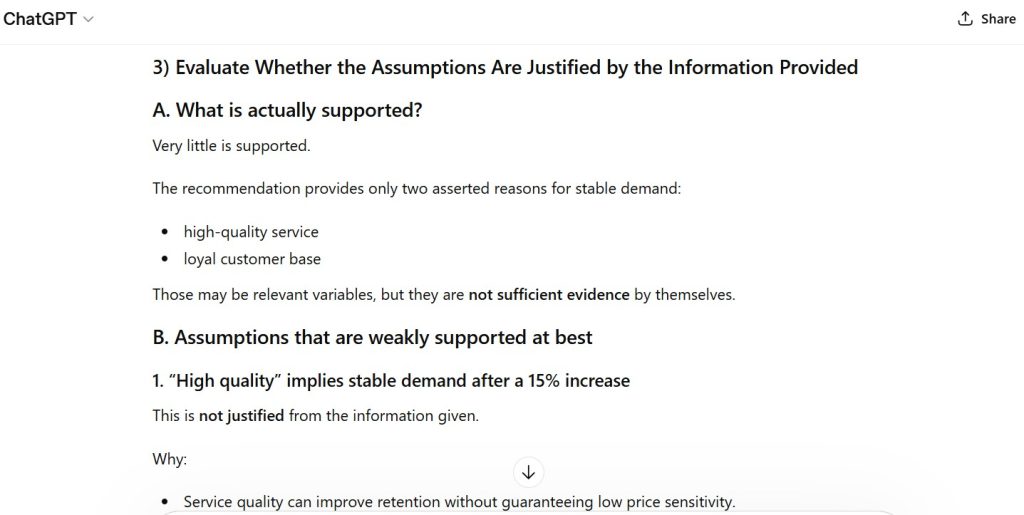
The model determined that the recommendation is weakly supported, with key assumptions (quality-driven demand stability and loyalty resilience) lacking sufficient evidence.
Figure 4 — Logical Integrity Assessment
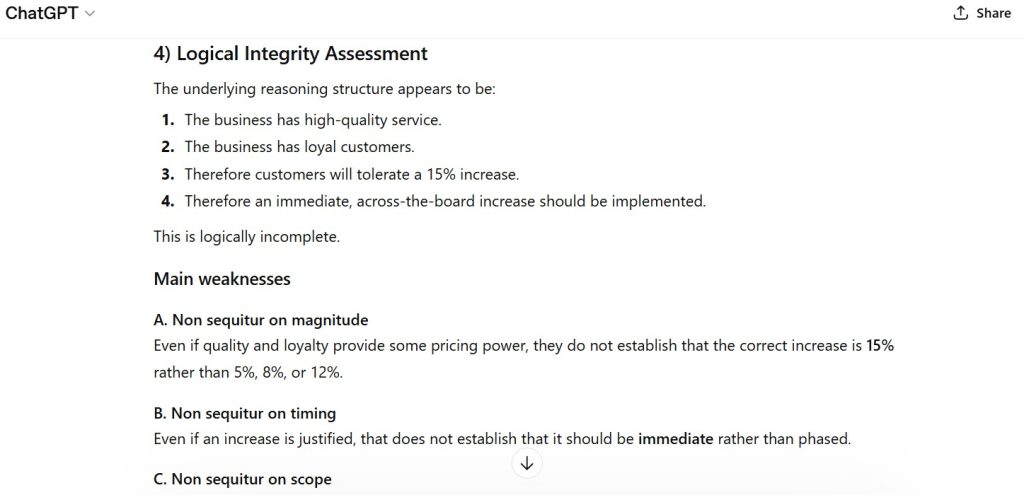
The response identified structural reasoning flaws, including non sequitur relationships in magnitude (15%), timing (immediate), and scope (uniform application), along with overstatement of certainty.
Figure 5 — Sensitivity Analysis of Assumptions
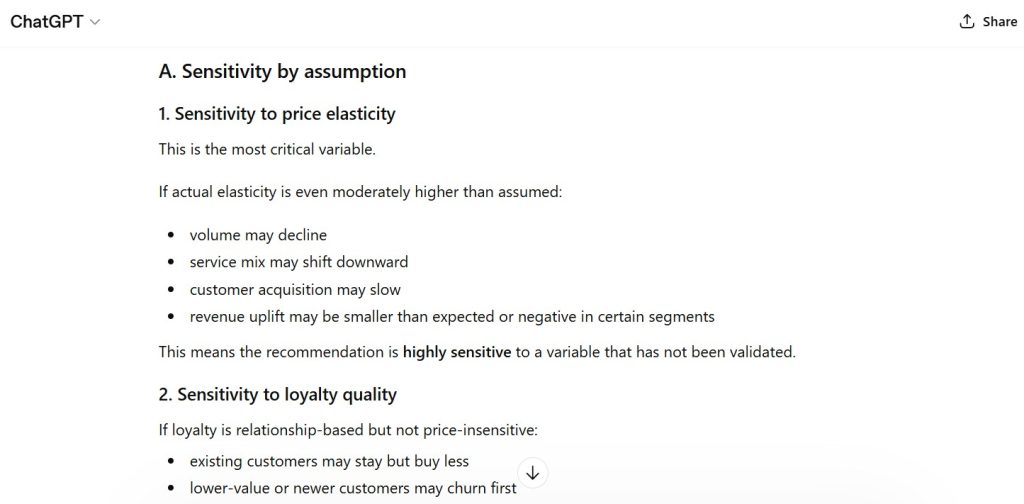
The model demonstrated that the recommendation is highly sensitive to changes in core assumptions, particularly price elasticity, loyalty behavior, service-line heterogeneity, timing, and competitive context.
Figure 6 — Reconstructed Decision Framework
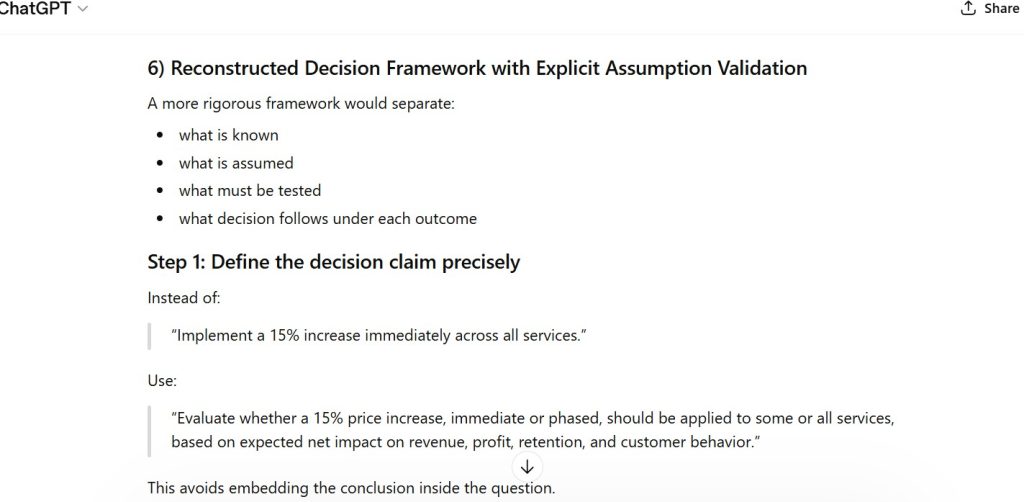
A structured decision framework was introduced incorporating:
• explicit assumption definition
• validation methods
• scenario-based decision logic
• measurable decision thresholds
• feedback and monitoring mechanisms
Figure 7 — Revised Recommendation Logic
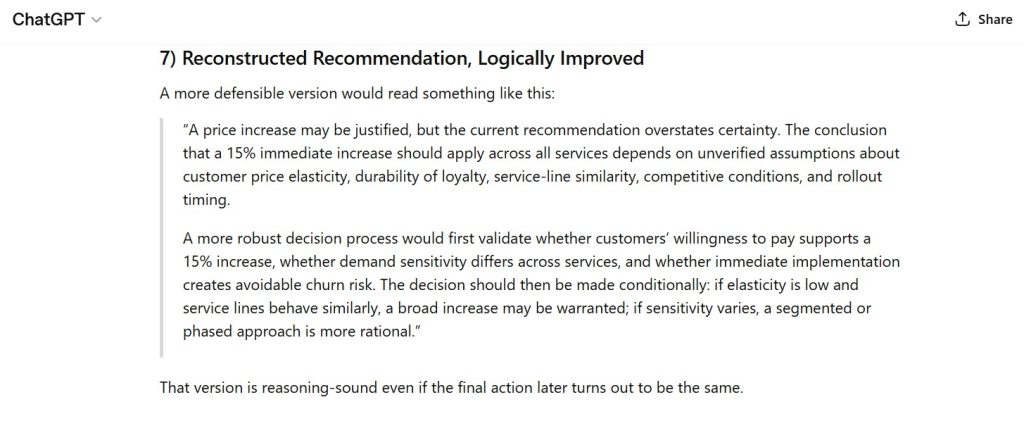
The model reformulated the recommendation into a conditional decision process dependent on validated assumptions rather than fixed conclusions.
Figure 8 — Bottom-Line Assessment
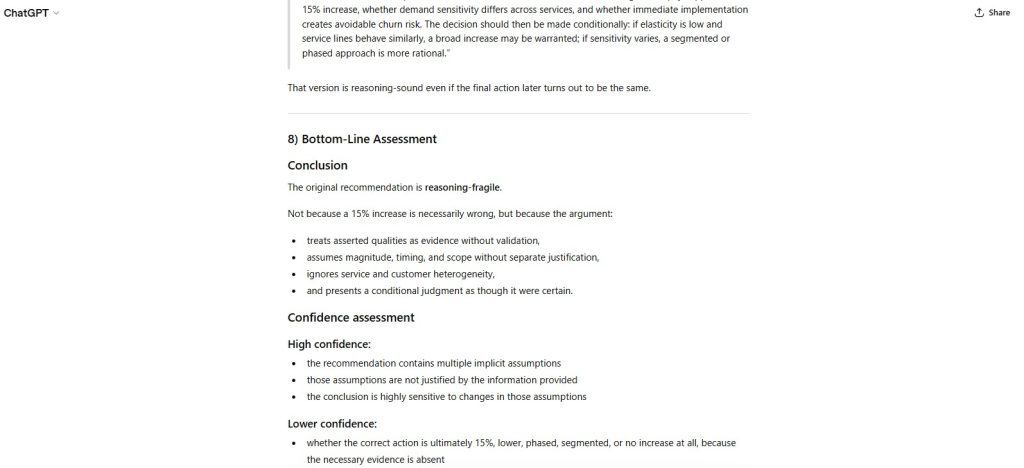
The final assessment classified the original recommendation as reasoning-fragile due to reliance on unvalidated assumptions and overstated certainty.
Capability Domain Evaluated
Assumption Sensitivity
This domain tests the model’s ability to:
• evaluate how outcomes depend on underlying assumptions
• identify which variables materially affect decisions
• assess robustness under changing conditions
• distinguish stable conclusions from fragile ones
• apply conditional reasoning under uncertainty
Sensitivity analysis is critical because decision outcomes can change significantly when underlying assumptions vary
Observed Strengths
• Comprehensive identification of assumption dependencies
• Clear separation of facts, assumptions, and inferred logic
• Strong sensitivity mapping across multiple variables
• Recognition of non-linear impacts (elasticity, segmentation)
• Structured transition from deterministic to conditional reasoning
• Integration of validation methods into decision framework
The output demonstrates strong capability in evaluating decision robustness under uncertainty.
Observed Constraints
• No quantitative modeling of elasticity or revenue impact
• Sensitivity analysis remains qualitative rather than numerical
• No probabilistic ranges or scenario weighting
• External market data not incorporated
• Interaction effects between variables not fully modeled
The analysis identifies fragility but does not simulate outcome distributions.
Failure Mode Classification
Assumption Sensitivity Failure
The test evaluates the model’s ability to detect when conclusions are highly dependent on unvalidated or unstable assumptions.
Institutional Assessment
The model demonstrates strong capability in identifying and evaluating assumption sensitivity within structured decision scenarios.
It successfully:
• exposes hidden dependency structures within recommendations
• identifies which assumptions are load-bearing
• evaluates robustness under variable change conditions
• reconstructs decision logic using conditional frameworks
The model performs particularly well in transforming deterministic conclusions into testable, evidence-based decision processes.
Performance in this assessment indicates strong capability in assumption sensitivity analysis.
Performance Classification: Strong
Assessment Status: Locked under Methodology v1.0
Structural revisions require formal version update.
— First Tier Review
Leave a Reply