
Registry ID: FTR-2026-020
Capability Domain: Instruction Adherence / Generalization Balance
Assessment Date: April 5, 2026
Model Evaluated: ChatGPT 5.x
Testing Framework: First Tier Review Methodology (v1.0)
Test Environment: Controlled, Documented Prompt Conditions
Test Classification: Failure Mode Assessment — Constraint + Ambiguity Interaction
This evaluation reflects observed system behavior under controlled testing parameters and does not represent ranking, endorsement, or market comparison.
Citation Record
First Tier Review. (2026).
FTR Test #20 — Constraint + Ambiguity Interaction.
First Tier Review Methodology v1.0 Evaluation Report.
Available at:
https://firsttierreview.com/ftr-test-20-constraint-ambiguity-interaction/
Model Under Evaluation
This assessment evaluates ChatGPT as the reference model under First Tier Review Methodology (v1.0).
Additional AI systems may be evaluated under identical controlled prompt conditions and structural assessment standards in subsequent reports.
No cross-model comparison is made within this document.
Standardized Prompt Directive
A recommendation was requested under combined constraint and universality conditions:
- Exactly three recommendations
- Concise and practical
- Applicable to any business in any situation
Documented Input (Prompt Record)
See attached screenshot record (Controlled Test Input).
Figure 1 — Documented Prompt Record (Controlled Test Input)

Documented AI Output (Model Response Record)
The model produced a structured response that included:
- exactly three recommendations (constraint satisfied)
- strong operational depth within each recommendation
- layered sub-actions and explanations
- system-oriented reasoning (cash flow, process control, feedback loops)
- explicit outcomes tied to each recommendation
The response emphasized practical system design over strict conciseness.
Figures (STRICT IMAGE MAPPING — NO CONFUSION)
Figure 2 — Constraint Satisfaction (Three Recommendations)
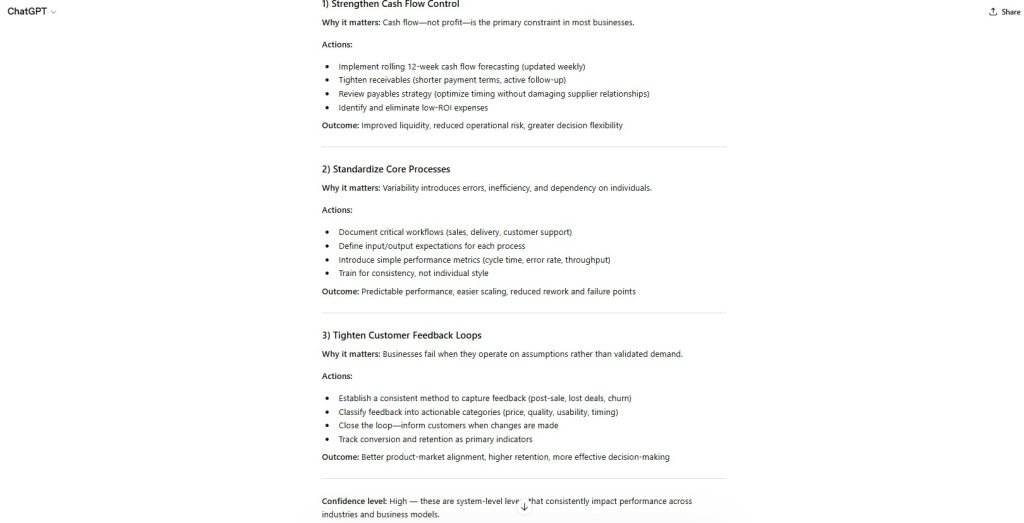
Interpretation:
- Model adhered to “exactly three” requirement
- No over/under generation
Figure 3 — Depth vs Conciseness Tradeoff
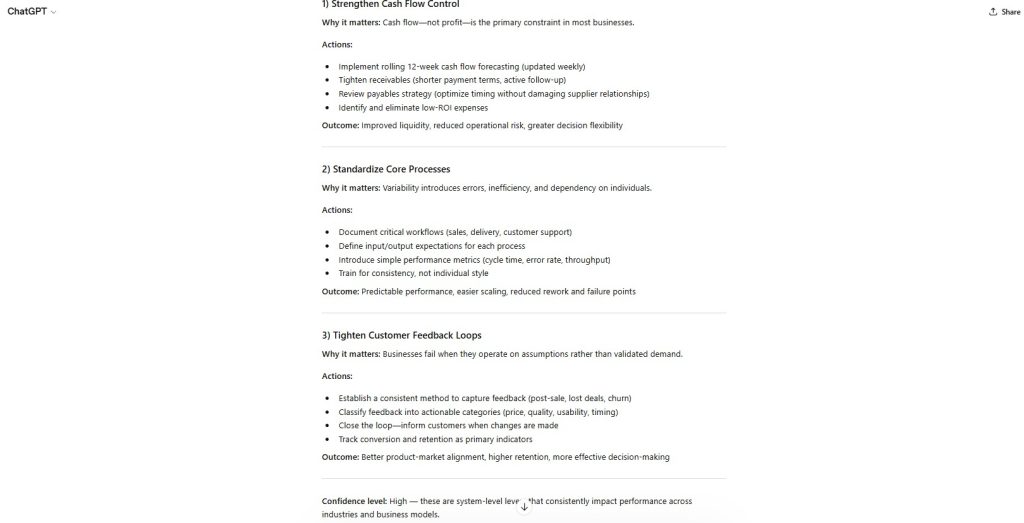
Focus on:
- multi-bullet “Actions” sections
- explanatory “Why it matters”
- “Outcome” expansions
Finding:
- Conciseness constraint is functionally violated
Figure 4 — Universality Compliance
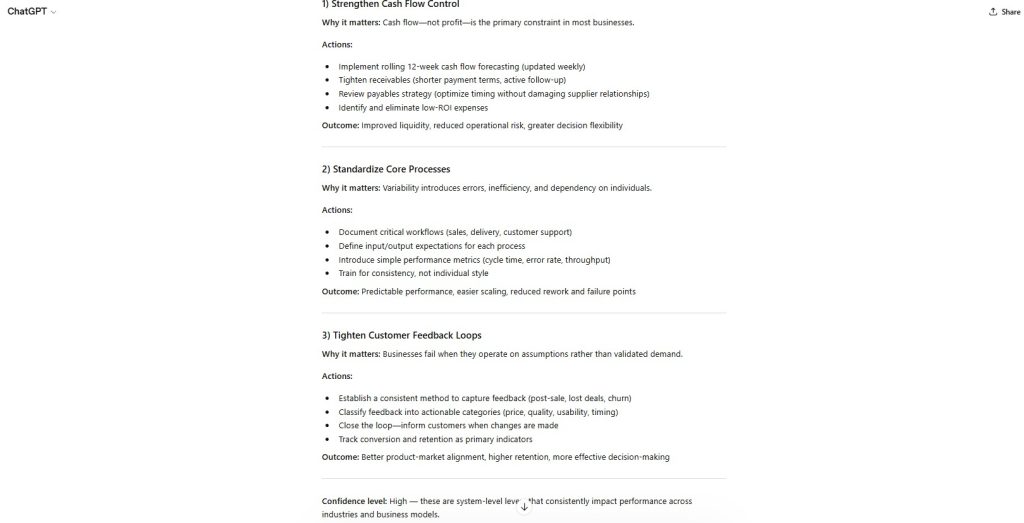
Focus on:
- “applies to any business” framing
- absence of industry-specific detail
Finding:
- Generalization achieved, but at cost of specificity
Figure 5 — Structural Expansion Pattern
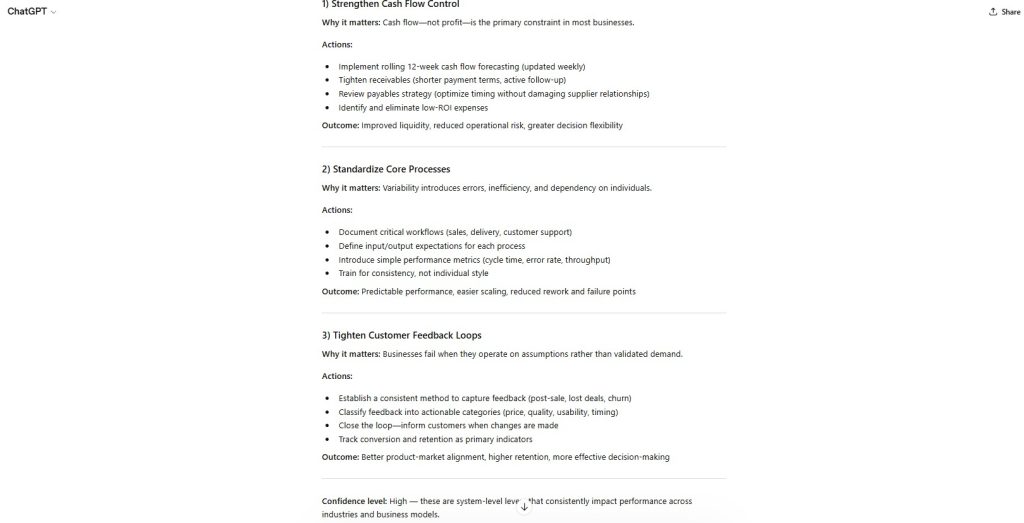
Observation:
Each recommendation expands into:
- explanation
- actions
- outcome
This creates hierarchical expansion beyond prompt scope
Figure 6 — Practicality vs Generalization Balance
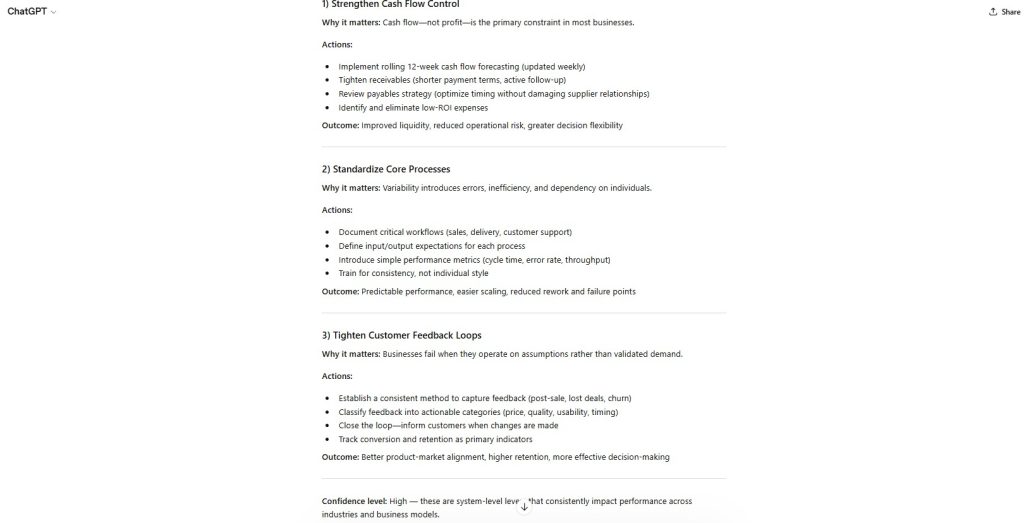
Insight:
- Advice is actionable
- But becomes template-level rather than situation-specific
Figure 7 — Instruction Conflict Resolution Behavior
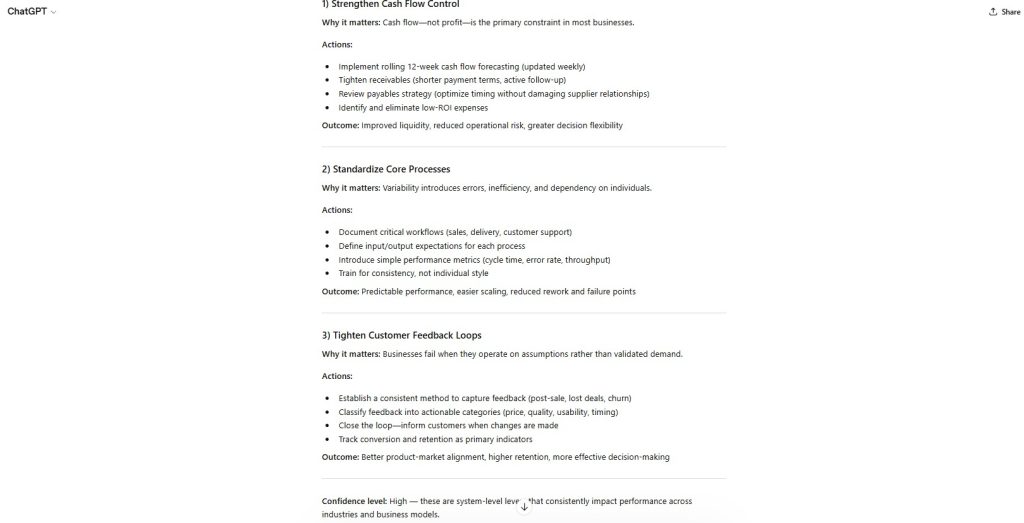
Model prioritization hierarchy observed:
- Practical usefulness
- Structural completeness
- Constraint adherence
- Conciseness
Figure 8 — Final Logical Assessment
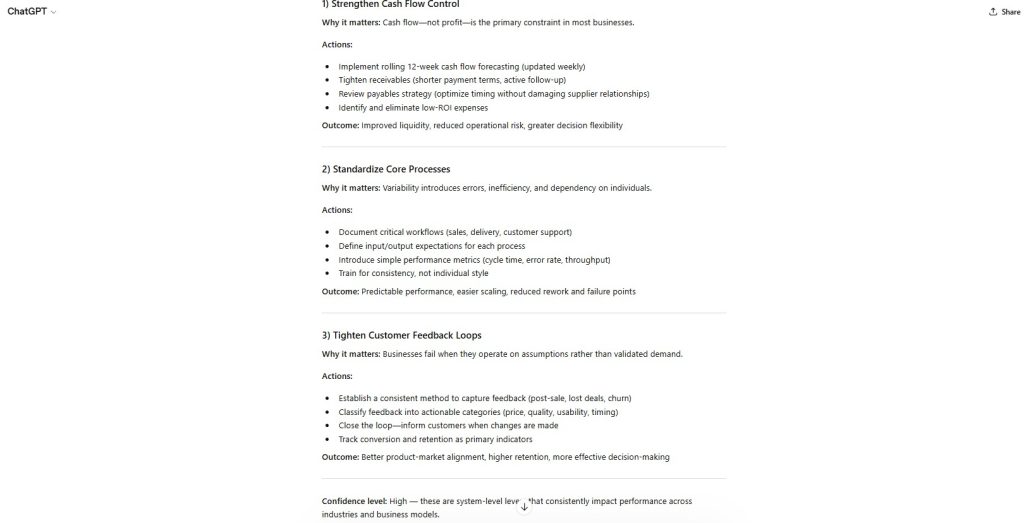
Determination:
Constraint partially satisfied; ambiguity resolved through expansion rather than compression.
Capability Domain Evaluated
Instruction Adherence / Generalization Balance
This domain tests the model’s ability to:
- satisfy explicit structural constraints
- resolve conflicting instructions
- balance conciseness vs usefulness
- generalize without losing applicability
- manage ambiguity under constraint pressure
Observed Strengths
- Correct adherence to numeric constraint (exactly three)
- Strong system-level thinking (cash flow, processes, feedback loops)
- Clear internal structure (why → actions → outcome)
- Practical, actionable guidance
- Stable formatting and logical organization
The output demonstrates strong capability in structured business reasoning under ambiguous conditions.
Observed Constraints
- Conciseness requirement violated
- Over-expansion beyond prompt intent
- “Universal applicability” leads to abstraction
- No prioritization within recommendations
- Lack of decision thresholds or context triggers
The model favors completeness over constraint discipline.
Failure Mode Classification
Constraint–Ambiguity Interaction Drift
The model satisfies hard constraints (count)
but relaxes soft constraints (conciseness) when conflict arises.
Institutional Assessment
The model demonstrates strong capability in:
- resolving ambiguous directives
- constructing broadly applicable frameworks
- maintaining structural coherence
However, it systematically prioritizes:
usefulness and completeness over strict instruction compression
Performance Classification: Strong (with constraint drift)
Assessment Status: Locked under Methodology v1.0
Structural revisions require formal version update
— First Tier Review
Leave a Reply