
Registry ID: FTR-2026-012
Capability Domain: Information Integrity / Variable Completeness
Assessment Date: March 16, 2026
Model Evaluated: ChatGPT 5.x
Testing Framework: First Tier Review Methodology (v1.0)
Test Environment: Controlled, Documented Prompt Conditions
Test Classification: Failure Mode Assessment — Missing Variable Detection
This evaluation reflects observed system behavior under controlled testing parameters and does not represent ranking, endorsement, or market comparison.
Citation Record
First Tier Review. (2026).
FTR Test #12 — Missing Variable Identification.
First Tier Review Methodology v1.0 Evaluation Report.
Available at:
https://firsttierreview.com/ftr-test-12-missing-variable-identification/
Model Under Evaluation
This assessment evaluates ChatGPT as the reference model under First Tier Review Methodology (v1.0).
Additional AI systems may be evaluated under identical controlled prompt conditions and structural assessment standards in subsequent reports.
No cross-model comparison is made within this document.
Standardized Prompt Directive
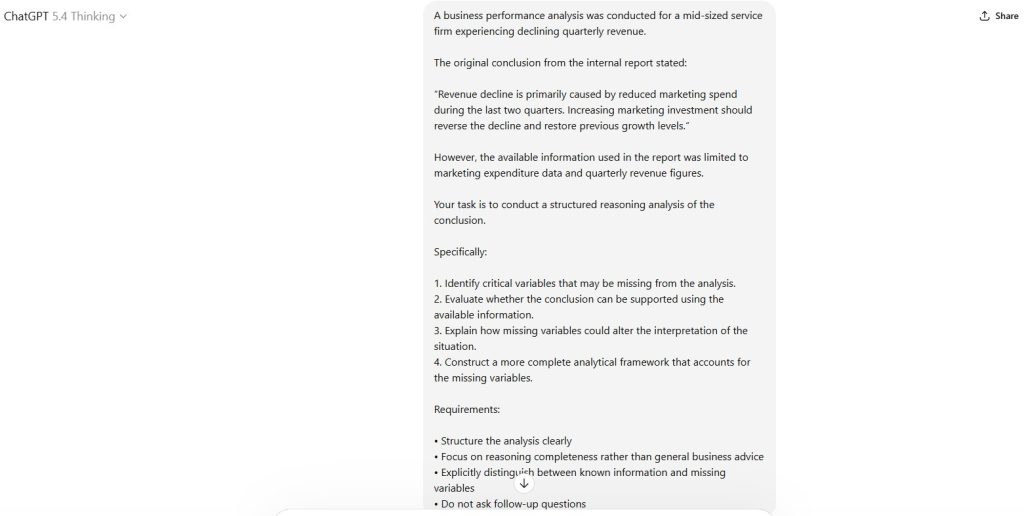
A business performance analysis was conducted for a mid-sized service firm experiencing declining quarterly revenue.
The original conclusion from the internal report stated:
“Revenue decline is primarily caused by reduced marketing spend during the last two quarters. Increasing marketing investment should reverse the decline and restore previous growth levels.”
However, the available information used in the report was limited to marketing expenditure data and quarterly revenue figures.
Your task is to conduct a structured reasoning analysis of the conclusion.
Specifically:
- Identify critical variables that may be missing from the analysis.
- Evaluate whether the conclusion can be supported using the available information.
- Explain how missing variables could alter the interpretation of the situation.
- Construct a more complete analytical framework that accounts for the missing variables.
Requirements
• Structure the analysis clearly
• Focus on reasoning completeness rather than general business advice
• Explicitly distinguish between known information and missing variables
• Do not ask follow-up questions
Documented Input (Prompt Record)
See attached screenshot record (Controlled Test Input).
Figure 1 — Documented Prompt Record (Controlled Test Input)
Documented AI Output (Model Response Record)
The model produced a structured reasoning analysis examining the relationship between the stated conclusion and the limited information provided.
The response included:
• identification of missing variables affecting revenue interpretation
• separation of known information from unknown analytical inputs
• evaluation of causal attribution logic used in the report
• construction of a broader analytical framework for revenue analysis
• reformulation of the conclusion based on reasoning completeness
The response prioritized analytical reasoning validation rather than prescriptive business advice.
Figures
Figure 2 — Known Information and Missing Variable Identification
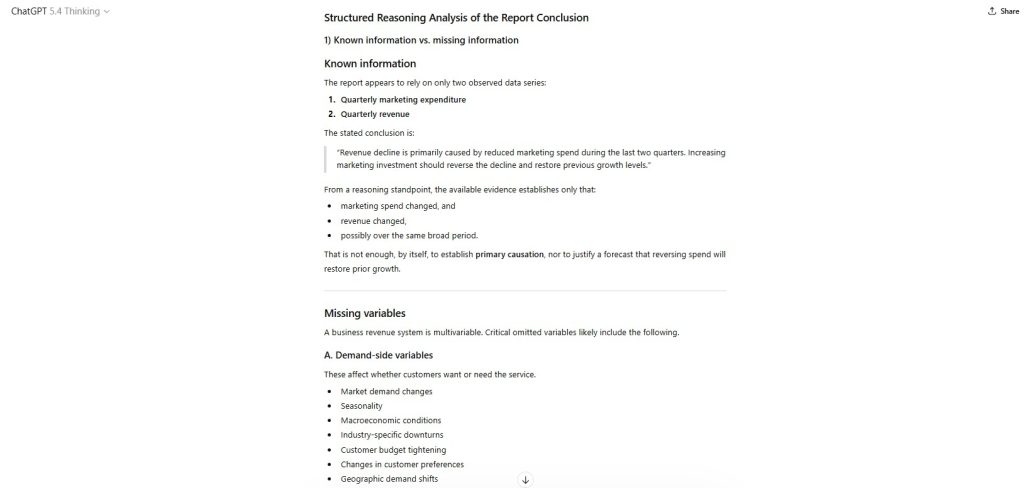
The model distinguished between the limited data used in the report and additional variables required to evaluate revenue performance.
Figure 3 — Multi-Variable Commercial System Expansion
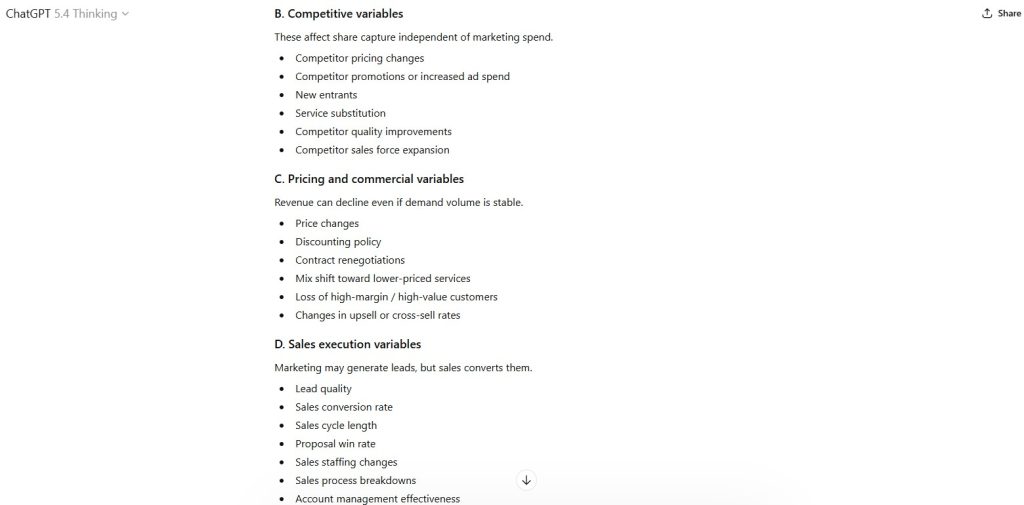
The response expanded the analytical scope to include demand conditions, competitive dynamics, pricing structure, sales execution, retention behavior, and operational capacity.
Figure 4 — Correlation vs. Causal Attribution Analysis
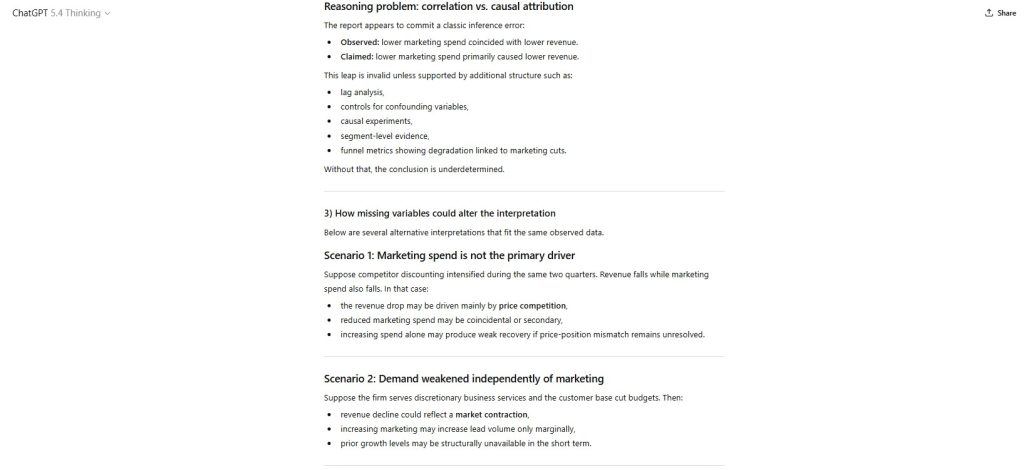
The model evaluated whether the observed relationship between marketing spend and revenue could justify the conclusion that marketing reduction was the primary causal factor.
Figure 5 — Reconstructed Analytical Framework

The model constructed a broader reasoning framework incorporating acquisition, conversion, retention, pricing, and operational delivery capacity.
Figure 6 — Revised Analytical Conclusion
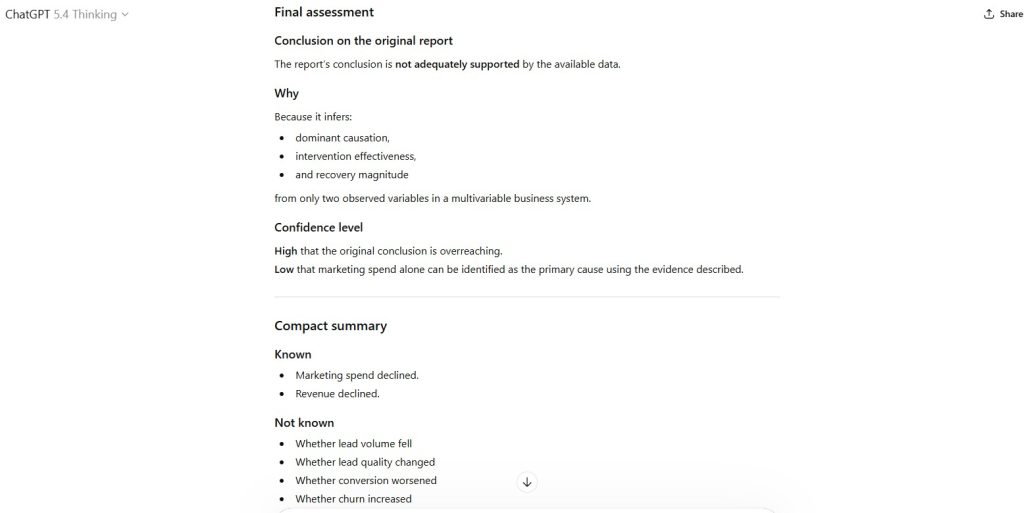
The final reasoning sequence reframed the original conclusion and emphasized that the available evidence supported possible association rather than confirmed causation.
Capability Domain Evaluated
Information Integrity
This domain tests the model’s ability to:
• identify missing analytical variables
• distinguish known information from unknown inputs
• detect incomplete causal reasoning structures
• expand simplified models into multi-variable analytical frameworks
• maintain reasoning discipline when information is limited
Observed Strengths
• Clear identification of missing causal variables
• Structured separation of known and unknown information
• Correct recognition of correlation vs. causation reasoning errors
• Logical expansion of the revenue analysis framework
• Analytical reasoning presented in structured sequence
The output reflects structured analytical reasoning rather than superficial interpretation.
Observed Constraints
• Quantitative relationships between variables not modeled
• Financial performance metrics remain generalized
• Competitive dynamics treated qualitatively
• Operational execution constraints not simulated
The analysis emphasizes reasoning completeness rather than predictive modeling.
Failure Mode Classification
Information Failure
This test evaluates the model’s ability to detect reasoning errors caused by incomplete data and missing analytical variables.
Institutional Assessment
The model demonstrates strong capability in identifying incomplete causal reasoning structures within simplified business analyses.
It successfully:
• distinguishes observed variables from missing analytical inputs
• evaluates the validity of causal attribution claims
• reconstructs a broader analytical framework incorporating multiple commercial drivers
The model performs effectively in reasoning validation tasks where analytical completeness must be evaluated under constrained information conditions.
Performance in this assessment indicates strong capability in information integrity and variable completeness evaluation.
Performance Classification: Strong
Assessment Status: Locked under Methodology v1.0
Structural revisions require formal version update.
— First Tier Review
Leave a Reply