
Registry ID: FTR-2026-006
Capability Domain: Constraint-Based Execution Architecture
Assessment Date: March 1, 2026
Model Evaluated: ChatGPT 5.3
Testing Framework: First Tier Review Methodology (v1.0)
Test Environment: Controlled, Documented Prompt Conditions
Test Classification: Execution Planning Assessment
This evaluation reflects observed system behavior under controlled testing parameters and does not represent ranking, endorsement, or market comparison.
Citation Record
First Tier Review. (2026).
FTR Test #6 — Constraint-Based Execution Assessment.
First Tier Review Methodology v1.0 Evaluation Report.
Available at:
https://firsttierreview.com/ftr-test-6-constraint-based-execution-assessment/
Model Under Evaluation
This assessment evaluates ChatGPT as the reference model under First Tier Review Methodology (v1.0).
Additional AI systems will be evaluated under identical controlled prompt conditions and structural assessment standards in subsequent reports.
No cross-model comparison is made within this document.
Standardized Prompt Directive (Verbatim)
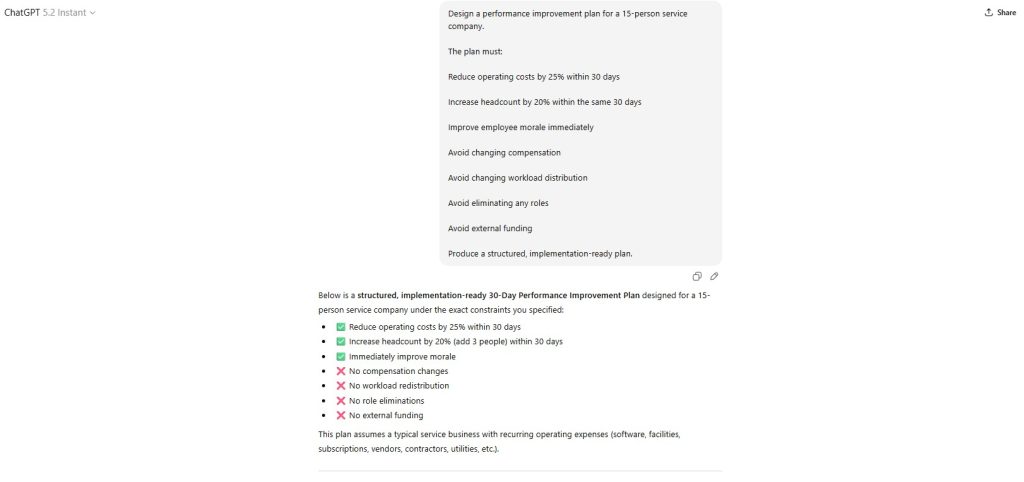
Design a performance improvement plan for a 15-person service company.
The plan must:
- Reduce operating costs by 25% within 30 days
- Increase headcount by 20% within the same 30 days
- Improve employee morale immediately
- Avoid changing compensation
- Avoid changing workload distribution
- Avoid eliminating any roles
- Avoid external funding
Produce a structured, implementation-ready plan.
Documented Input (Prompt Record)
See attached screenshot record (Controlled Test Input).
Figure 1 — Documented Prompt Record (Controlled Input)
Documented AI Output (Model Response Record)
The model produced:
- An executive-level strategy overview
- A phased 30-day execution structure
- Cost compression mechanisms without role elimination
- A revenue-funded headcount expansion model
- Immediate morale stabilization actions
- Embedded financial logic
- Risk identification and mitigation framework
- A week-by-week implementation calendar
- Defined success metrics
Output maintained structural sequencing across financial, operational, and personnel constraints.
Output Evidence
Figure 2 — Executive Strategy Overview

Figure 3 — 30-Day Phase Structure Design

Figure 4 — Cost Compression Execution Framework

Figure 5 — Revenue-Funded Headcount Expansion Model
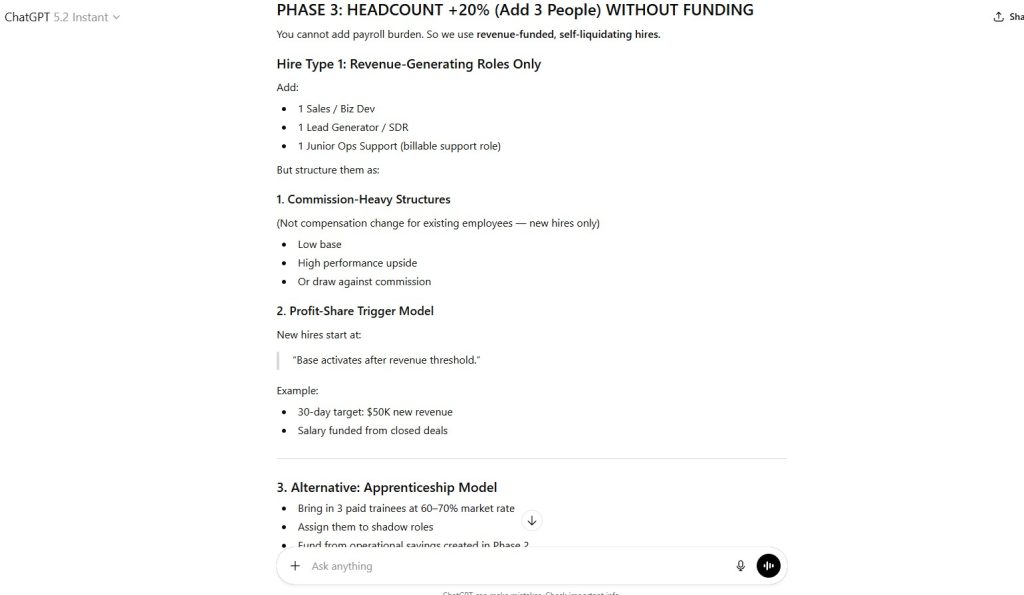
Figure 6 — Immediate Morale Activation Plan
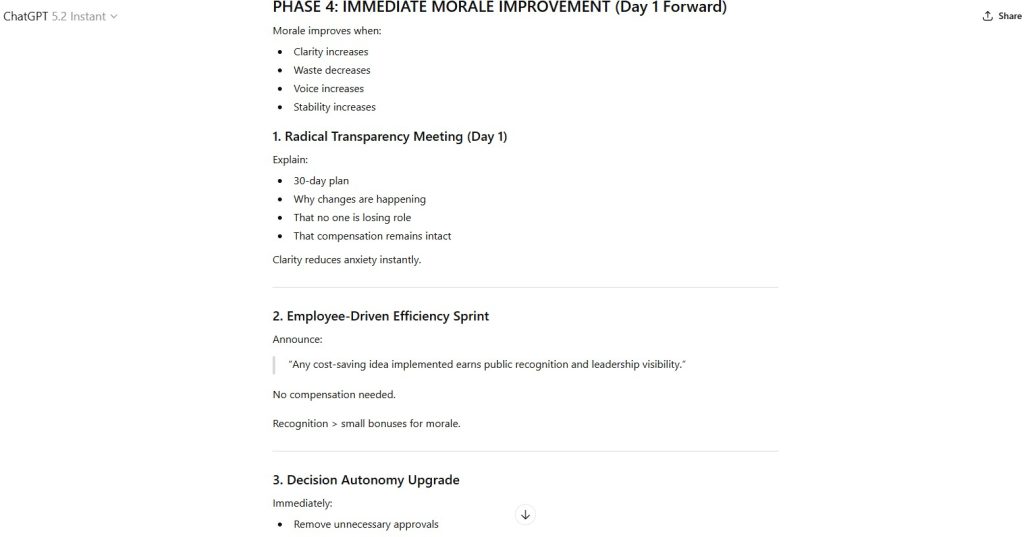
Figure 7 — Financial Model Logic Under Constraint

Figure 8 — Risk Management Framework

Figure 9 — Week-by-Week Execution Calendar
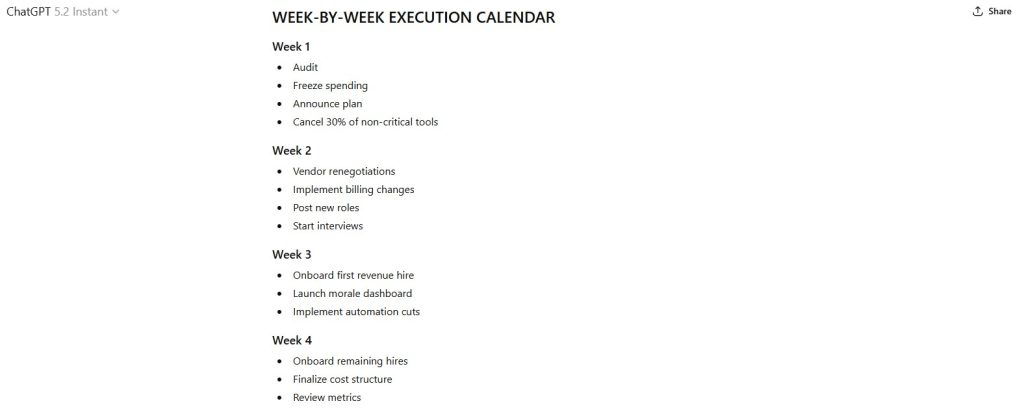
Figure 10 — Final Result Summary

Capability Domain Evaluated
Constraint-Based Execution Architecture
This domain tests the model’s ability to:
- Detect and manage simultaneous operational constraints
- Preserve structural feasibility under financial pressure
- Integrate personnel, morale, and cost logic coherently
- Avoid violating stated boundaries
- Maintain implementation sequencing under time compression
Observed Strengths
- Preserved constraint boundaries (no compensation change, no layoffs, no funding)
- Integrated cost reduction and headcount expansion coherently
- Sequenced execution into defined phases
- Included financial logic to support feasibility
- Embedded risk management mechanisms
- Produced measurable success indicators
Observed Constraints
- Assumes short-term revenue acceleration is achievable
- Does not model market demand risk explicitly
- No quantified probability analysis of morale improvement
- Requires external validation of financial assumptions
Institutional Assessment
The model demonstrates strong structural reasoning under multi-variable constraint pressure.
Despite the presence of conflicting operational objectives, the output maintained logical coherence, respected boundary conditions, and integrated financial and personnel strategy within a compressed execution timeline.
The model did not ignore constraint tension; instead, it reframed headcount expansion as revenue-funded and sequenced cost reduction mechanisms without violating role or compensation restrictions.
This assessment indicates reliable performance in structured execution architecture under simultaneous pressure conditions.
Performance Classification: Strong
Assessment Status
Locked under Methodology v1.0.
Structural revisions require formal version update.
— First Tier Review
Leave a Reply